
                   |
-
S -
Sabbath.
A period of rest associated with the number seven. In Hebrew, the noun
"Sabbath" is shabbâth (7676),
related to the verb shâbath (07673),
meaning, "to cease, desist, rest." It is also closely associated, in
certain texts, with the number seven, sheba‛
(7651).
The first occurrence of "Sabbath" in the OT was in
Exodus 16:23,
wherein the people of Israel
were to be given enough manna on the sixth
day of the week so that they would have enough left over for the
seventh day, which was a "Sabbath" (rest) to the Lord (Exod 16:23, 25,
26, 29). They were not to attempt to search for manna on the seventh
day, for God would give them none. They were later instructed to keep
the Sabbath day holy, not performing any work (Exod. 20:8, 10). This
command harkens back to God's hallowing the seventh day and resting on
it, having ceased from His creative work (Exod. 20:11).
The Sabbath is especially a sign between God and the nation Israel (Exod. 31:16-17). It commemorates God's creation of the heavens and the earth and His resting on the seventh day. Not only were the Israelis to observe a Sabbath of days, but also a Sabbath of years. For six years Israells were free to plant and harvest a crop on their land. But the seventh year was to be a Sabbath. They were not to cultivate the land or plant a crop. They were free to harvest the volunteer produce that grew up. But that was all. God promised them He would provide enough for them to eat during every seventh year that they were to let the land lie fallow (Lev. 25:1-7). Moreover, Hebrew slaves were to be set free on the seventh year also (Exod. 21:2; Deut. 15:12). The Israelis were also to count a series of seven seven-year periods. Not only was the seventh year of the seventh period to be a year to let the land lie fallow, but also the fiftieth year. This was a year of "Jubilee." During the year of Jubilee all land and property was to revert back to its original owner, and all slaves were to be released (Lev. 25:8-55). But Israel failed to observe the Lord's Sabbaths. Finally, God sent the nation into exile in Babylon for seventy years to make sure His land observed the Sabbaths that Israel had failed to keep (Lev. 26:32-35; 2 Chron. 36:20-21). Sadducee, Sadducees. A more liberal sect of Judaism at the time of the New Testament, often allied with ruling Priests in Israel (Acts 4:1; 5:17). There was tension between the Sadducees and the more conservative sect of Judaism at that time, the Pharisees. (Acts 23:6, 7, 8). But the two sects cooperated with one another to try to entrap Jesus (Matt. 16:1). Jesus considered both sects as teaching false doctrine (Matt. 16:5-12; see esp. Matt. 16:1, 6, 11, 12). The Sadducees in particular, falsely taught that there is no such thing as a resurrection (Matt. 22:23; Mark 12:18; Luke 20:27; Acts 23:28). They also taught falsely that there is no such thing as an angel or spirit (Acts 23:28). The ruling Council, or Jewish Supreme Court consisted of both Pharisees and Sadducees (Acts 23:6). That Council conspired to convict Jesus falsely of blasphemy, and to lobby for His death (Matt. 26:59; Mark 14:55; 15:1; Luke 22:66). Saints. Ones set apart to God from sin through faith in Jesus, primarily referring to New Testament believers in Christ. This becomes a fairly standard designation for New Testament Christians. Saints are, by designation, members of the Universal (or Catholic) Church (Rom. 8:27; 1 Cor. 1:2; 6:2; 14:33; 2 Cor. 13:13; Eph. 1:15, 18; 2:19; 3:8, 18; 4:12; Col. 1:4, 12, 26; 2 Thess. 1:10; 1 Tim. 5:10; Jude 1:3; Rev. 5:8; 8:3, 4; 11:8; 13:7, 10; 14:12; 16:7; 17:6; 18:20, 24; 19:8) as well as participants in a particular local church (Acts 9:13, 32, 41; Rom. 1:7; 15:25, 26, 31; 16:15; 1 Cor. 1:2; 16:1, 15; 2 Cor. 1:1; 8:4; 9:1, 12; Eph. 1:1; Php. 1:1; 4:21, 22; Col. 1:2; Phm. 1:5, 7; Heb. 6:10; 13:24). Roman Catholicism speaks of "the communion of saints": The
communion of saints is the spiritual solidarity which binds together
the faithful on
earth, the souls in purgatory,
and the saints in heaven in
the organic unity of the same mystical
body under Christ its head, and in a constant interchange
of supernatural offices.
The participants in that solidarity are called saints by reason of
their destination and of their partaking of the fruits of the Redemption (1
Corinthians 1:2 — Greek Text).
This is, for the most part, a Biblically accurate statement. There is, of course, no Biblical reference to purgatory, and I doubt the validity of the term "constant interchange of supernatural offices" (I do not know what Catholics mean by that phraseology). The whole notion of Beatification and Canonization of saints, moreover, is completely unbiblical, and should be rejected as Roman Catholic mythology. Salvation. God’s saving man from the horrible consequences of sin. The Greek word translated "salvation" in the New Testament is the word sôtêria (4991). The Friberg Analytical Lexicon translates the Greek word sôtêria as "salvation, deliverance." Friberg describes salvation under three headings: (1) Physical salvation, a rescue from danger. It equates this meaning to several synonyms, including "deliverance, preservation, safety". It gives Hebrews 11:7 as an example. (2) Spiritual salvation - a "religious technical term for safety of the soul in a spiritual sense. The chief synonym is "salvation," and the Scripture reference given is 2 Corinthians 7:10. (3) Friberg's third use is "of the messianic deliverance at the end of the present age." The chief synonym is "salvation," and the best reference is Romans 13:11. I am uncertain as to what Friberg, et al mean by "messianic deliverance at the end of the present age." I doubt they mean the same thing as I. To me, Messianic Deliverance at the end of the present age cannot exclude political salvation for the nation of Israel. And that political salvation cannot be dissociated from spiritual salvation. Moreover, that political salvation will also be extended to the Gentile nations of the world. Aspects of Salvation Examples of physical salvation (i.e. physical deliverance) include Acts 27:34; Philippians 1:19; Heb. 11:7. A specialized physical deliverance is the prospect that the church has of being physically delivered from the earth and thus being exempted from the horrors of the Tribulation period (1 Thess. 5:9; 2 Thess. 2:13). Examples of spiritual salvation (i.e. deliverance of the soul from the ravages of sin and eternal judgment) include Luke 19:9; Romans 10:10; 11:11; Acts 4:12; Eph. 1:13; 1 Pet. 1:9-10; 1 Pet. 2:2; Jude 1:3. Examples of national salvation (deliverance for Israel) include Rom. 10:1; 11:25-27; for individuals from among the Jewish and Gentile nations, Rom. 1:16. Examples of ultimate salvation (deliverance of the soul from sin and the body from the cursed effects associated with sin) include Rom. 13:11; 1 Thess. 5:8; 2 Tim. 2:10; Heb. 1:14; 5:9; 9:28; 1 Pet. 1:5; Rev. 12:10. A Discussion of Spiritual Salvation. Because
Adam’s sin has been imputed
to all
mankind; because man has been contaminated with a sin
nature
that he has inherited from Adam; and because each man personally commits
acts of
sin, he is under a death sentence. This
death sentence includes, in the first place, a separation of man from
God (Spiritual Death); in the second
place an eventual
separation of man’s soul from his body (Physical Death); and in the
third place an ultimate
eternal separation of man from God in the Lake of Fire and
Brimstone (Second Death). Since
man is hopelessly dead in his trespasses and
sins (Eph. 2:1), cruelly
energized by Satan (Eph. 2:2), helplessly ensnared by his own sinful
flesh (Eph. 2:3), and
inevitably
influenced by the corrupt world in which he lives (Eph. 2:2), God has
had to take
the
initiative in rescuing man from his hopeless plight.
From
eternity past God reached out to mankind (Rev. 13:8).
In His great love for man, He sent His Son to become
man, to live a
perfect life, to die a perfect death for the sins of all, to be
resurrected,
and to ascend to heaven to be seated at God’s right hand in a position
of great
power and prominence. Man is
saved from the
deadly consequences of sin by accepting God’s viewpoint on the evil of
his own
sins, by believing in the efficacy of Jesus Christ’s sacrifice for his
sins,
and by placing his faith in Jesus Christ alone. In
consequence of this faith God grants to him
forgiveness and the gift
of eternal life. In
its ultimate form,
salvation (Rom.
1:16; Acts
4:12; 1 Tim. 2:3-4;
Tit. 2:11-14; Heb. 1:14; 9:28; 1 Pet. 1:5; 2 Pet. 3:15) includes
salvation of one’s soul and
one’s body from the guilt, consequences, and presence of sin in a saved
global
community on New
Earth and in its capital city, New
Jerusalem in
eternal fellowship with God, Christ, and the redeemed of all ages. There are a number of
terms that refer to
different aspects of salvation. From
the standpoint of God,
some of these terms include foreknowledge
(Rom. 8:29; 11:2), predestination
(Rom. 8:29, 30; Eph. 1:5, 11), calling
(Rom. 8:28, 30; 9:11; 1 Cor. 1:24; 2 Tim. 1:9; Rev. 17:14), drawing
(John
6:44)
(perhaps another term for the same concept as calling), justification,
glorification,
election
(Eph.
1:4),
inseparability (or perhaps better, security)
(John
10:14-16, 26-29; Rom. 8:1, 26-39), adoption
(Rom. 8:15, 23; 9:4; Gal. 4:5; Eph. 1:5), and reconciliation
(2
Cor. 5:18-19). From
the stand point of Jesus
Christ, some of these terms include ransom
(Mark
10:45), redemption
(Eph.
1:7; 1 Pet.
1:18), forgiveness
(Acts
10:43; 13:39), inheritance
(Eph.
1:11), advocacy
(1
John 2:1), propitiation
(1
John 2:2),
and intercession
(Rom.
8:34; Heb.
7:25; 9:24). (We sometimes use the word "atonement"
in reference to Jesus' sacrifice, but, technically, that is an OT word,
not a NT
word.) From
the standpoint of the Holy
Spirit, some of these terms include conviction
(John
16:8-11), baptism
(1
Cor. 12:13), indwelling
(John
14:17; Rom. 8:9; 1 Cor. 6:19), regeneration
(Tit.
3:5), intercession
(Rom. 8:26, 27) and sealing
(Eph.
1:13-14; 4:30). From
the standpoint of the individual Christian and his response, some of
the
related terms include repentance (Matt.
3:2; 4:17; Mark 1:14-15; Luke 24:47; Acts 2:38; 5:31), faith
/ believe (Mark
1:15; John 3:16, 18, 36; 5:24; Acts 10:43; 13:39), receive (John
1:12), and
perseverance (Matt.
13:20-22; Rom. 5:3-4; Heb. 6:1; 10:22-23). Messianic Deliverance - Political and Spiritual Salvation for Israel Political Salvation for Israel There is no finer display of political and spiritual salvation for Israel than the prophetic, Spirit-filled prayer of Zacharias in Luke 1:67-79. In his prayer He blesses Israel's God, who has visited Israel "and accomplished redemption for His people, and has raised up a horn of salvation for us in the house of David His servant" (Luke 1:68-69). The word "horn" in this context speaks of a mighty ruler. In the context this must be a Davidic king. He can be referring to only one person, Jesus, anointed by God to be King of Israel. Zacharias prophesies that Jesus, a royal descendant of King David, will be a strong political ruler who will provide political salvation for the nation of Israel. Zacharias continues by noting that his prophecy agrees with the pronouncements of God's prophets from long ago (Luke 1:70). He continues by defining this political salvation: "Salvation from our enemies and from the hand of all who hate us" (Luke 1:71). Here he is quoting from Psalm 106:10. This political salvation to be achieved for Israel through Jesus Christ will be for the purpose of (a) showing mercy toward our fathers, and (b) remembering His holy covenant (Luke 1:72), which Zacharias defines as God's oath which He swore to Abraham our father (Luke 1:73). (c) Zacharias furthered described this salvation as "being rescued from the hand or our enemies" (Luke 1:74), inarguably, a political salvation. Spiritual Salvation for Israel But it is also clear from Zacharias' prophecy that he was not interested merely in political salvation for Israel. The purpose of Jesus' political salvation of Israel is so that we, "being rescued from the hand of our enemies, might serve Him without fear, in holiness and righteousness before Him all our days" (Luke 1:74). Furthermore, in the next portion of his prophecy (Luke 1:76-79), which deals with his own son (John the Baptist), Zacharias predicted his own son would "'go on before the Lord to prepare His ways; to give His people the knowledge of salvation by the forgiveness of their sins" (Luke 1:76-77). That is spiritual salvation. But in his last sentence Zacharias states the ultimate impact of Jesus' rule will be "to guide our feet in the way of peace" (Luke 1:79), which, once again, must include political salvation. Messiah's Second Coming and Subsequent Reign over Israel Israel's political / spiritual salvation will occur at her Messiah's Second Coming. (1) Israel will undergo national repentance (Zech. 12:10-13:1; Rom. 11:26). (2) God will take away Israelis' hearts of stone and give them hearts of flesh (Ezek. 11:19; 36:26). (3) This will come about because God will implement His New Covenant with Israel (Isa. 59:20-21; Jer. 31:33-34; Heb. 8:8-12). (4) This will take place during Christ's Millennial Reign from David's Throne in Mount Zion, Jerusalem, Israel (Zech. 14:9; Matt. 25:31; Rev. 20:4-6). (5) Israel will dwell in her land in peace and be elevated to the chief nation among all the nations of the world. (a) The earth's nations will serve Israel in the Millennium, embracing Zion as the City of Yahweh and His Davidic King, Jesus (Isa. 60:10-14). (b) Foreigners will perform menial tasks for Israelis (Isa. 61:5). (c) Because Israel will live in righteousness before Yahweh, He will bless her so that she will experience honor and respect among the earth's nations instead of humiliation and contempt (Isa. 61:7-9). (d) All nations of the world will assemble in Jerusalem to worship at appointed feasts and learn of God's ways from King Jesus (Isa. 2:1-4; Zech. 14:16-21). (e) All mankind will come to Jerusalem to bow down before Yahweh, present in the person of Jesus (Isa. 66:23). Eternal Salvation for Israel Israel's political / spiritual salvation during the time span of Christ's Millennial Kingdom will be wonderful. But the earth and universe have been cursed by man's sin. Both must be burned with fire (2 Pet. 3:7-12) and replaced by New Heavens and Earth (Isa. 65:17; 66:22; 2 Pet. 3:13; Rev. 21:1) in the Eternal State. New Jerusalem (Rev. 3:12; 21:2, 10) will be the capital city of New Earth. Israel will continue to be the leading nation of New Earth. (It goes without saying that God's eternal order cannot be more Jewish than New Jerusalem! The capital city of New Earth will not be called New York or New Delhi!). The names of the twelve tribes of the sons of Israel will be emblazoned on the twelve gates of the eternal city (Rev. 21:12). I believe the land of Israel will forever exist on New Earth in a recognizable configuration. It is my belief that New Jerusalem, as it is described, will orbit the earth much as our moon does today. It will shed light on New Earth below (Isa. 60:3; Rev. 21:24). Israel as a saved, redeemed nation will be the predominant nation over all the nations of New Earth, for Israel's King, Jesus, will reign with His Father in a co-regency from their throne (thronos, 2362) (Rev. 22:1, 3). Messianic Deliverance - Political and Spiritual Salvation for Gentiles The Messianic Reign of Christ over Gentiles on this Present Earth But "Messianic deliverance at the end of the present age" is not merely for Israelis. Hebrews 9:28 speaks of an ultimate deliverance from sin and all the gruesome consequences of sin, including death, disease, decay, and disunity. This deliverance will begin with the Second Coming of Christ. And this deliverance will benefit Gentiles also (Acts 13:47). With King Jesus seated on His throne in Jerusalem, nations from all over the world will come to worship Him and learn of His ways (Isa. 2:1-4). Implements of warfare will be transformed into implements of agriculture (Isa. 2:1-4). There will be universal peace, and nations will not waste their money on defense appropriations. These peaceful conditions will characterize the Millennial Reign of Christ (Rev. 20:4-6). This will be possible because Satan will have been bound for the entire thousand years of Christ's reign (Rev. 20:1-3). But Satan will be released from his temporary prison and will once again deceive the nations of the earth. They will attempt to revolt against the King, but will suffer fiery destruction (Rev. 20:7-10). The Messianic Co-Regency of Christ over Gentiles from New Jerusalem over New Earth Then God will obliterate the present order of things in a series of gigantic and noisy explosions (2 Pet. 3:7-12). Then He will create New Heaven and New Earth (2 Pet. 3:13; Rev. 21:1). Only the resurrected, redeemed will inhabit New Earth and its capital city, New Jerusalem (Rev. 20:11;15; 21:8, 27; 22:15, 19). New Earth will be the eternal home of redeemed Gentiles (Rev. 21:24-27) who were never a part of the Church. There will be business and agriculture upon New Earth. The earth's nations and kings will bring their honor and glory into New Jerusalem, bringing great honor to the King and sustenance for the City. There will be eternal, universal peace, and there will be no evil people present to disrupt perpetual harmony. The nations of New Earth will have 24-hour-a-day access to New Jerusalem (Rev. 21:24-26), where they will be refreshed by the river of life and the fruits and even the leaves of the tree of life (Rev. 22:1-2). Utopia will finally have arrived! Salvation
History. The
view of certain nonconservative Bible scholars that the Bible conveys a
history of redemption that is to be distinguished from actual or
factual history. The technical German term Heilsgeschichte
is often used as a synonym for Salvation History. Sadly, this skeptical
view of the Bible takes the position that very little in the Bible can
be taken as factual history, but only as a meaningful,
theologically-oriented story that is to be believed regardless of its
historical authenticity. In effect, they say, "We cannot trust the
historical statements of the Bible unless they can be confirmed by
extra-Biblical history. Many even question the value of archeology in
establishing the historicity of the Bible. This skeptical view actually
destroys the validity of Scripture, since so much theology is wedded in
events presented as historical reality in the Old Testament. "For as in
Adam all die, so also in Christ all will be made alive" (1
Cor. 15:22). If
there was no historical Adam, there is no assurance either that in
Christ, all will be made alive. See Bernhard W. Anderson's "The
Problem of Old Testament History" for an illustration of this
corrosive dogma regarding Scripture.
Samaria. The name of a city and a region in the land of Israel. This term appears primarily in the OT (109X), the noun shômerôn (8111). The NT noun is Samáreia (4540), used but 11X. King Omri, the sixth king of the Northern Kingdom of Israel, bought the hill of Samaria from Shemer. He built a city on the hill, fortified it, and named it Samaria after its previous owner, Shemer (1 Kings 16:23-24). The Northern Kingdom of Israel became identified as "Samaria." All of the Northern Kings were idolatrous for political purposes, and God judged them by having Assyria conquer the Northern Kingdom and deport most of the population to Assyria. The region was repopulated with people from other nations, and a syncretistic religion developed. Because of the worship at Samaria and because of the mixed race of the region, the Jewish people of Jesus day did everything they could to avoid contact with Samaritans. Jesus was different. He deliberately went through Samaria and led a number of Samaritans to faith in Himself (John 4:1-42). In His Great Commission He commanded that His followers be witnesses not only in Jerusalem and in Judea, but in Samaria, and to the ends of the earth (Acts 1:8). Samaritan, Samaritans. The adjective/noun describing people of Samaria. It may refer to inhabitants either of the city or the region of Samaria. The term "Samaritan" is strictly NT in usage. It appears 9X. The Greek word is Samareítēs (4541). The Samaritans were descendants of the Northern Kingdom, Israel. There was built-in enmity between the inhabitants of Samaria and Judea. But when the people of the Northern Kingdom were taken captive and replaced by foreigners conquered by the Assyrians (722 B. C.), the animosity ratcheted upwards because the replacement people brought in their false gods. The Assyrians attempted to reintroduce the true faith of the native people of Israel, but only partly succeeded, and syncretism took place. In Jesus' day, worshipers of the God of Israel from Galilee and Judea did everything they could to avoid contact with Samaritans. Jesus was different. He ascribed good character to a Samaritan man (Luke 10:30-37), and took special pains to introduce a Samaritan woman to faith in Himself (John 4:7-45). He also commanded His followers to be witnesses to Samaritans (Acts 1:8) Return
to the Top.
Sam
Storms.
An amillennial
online publisher. WordExplain
is always searching for resources to illustrate particular theological
and eschatological
points of view that are accessible online.
Sam Storms is one such resource. Unfortunately, all the links to his
website as of this writing are defunct
because he has created a new
website. These invalid links will be rectified in the near future.
Dr. Storms is unusual in that he
received his Master of Theology degree from Dallas
Theological Seminary, a bastion of dispensational
premillennialism, but does not subscribe to that viewpoint.
Unfortunately, in my view, he either became, or else remained,
an amillennialist.
I document that by referring the reader to his New
Testament Commentary Recommendations on Revelation, in which
his top recommendations for commentaries are amillennial.
It perhaps goes without saying, but I will say it anyway: I do not
believe amillennialism
accurately reflects God's kingdom program. It does not do so because it
refuses to employ a consistently literal hermeneutic
to the Scriptures. Consequently, there are a great many areas in eschatology
in which I strongly disagree with Dr. Storms. However, Storms at least
has the advantage of being able to portray accurately the dispensational
premillennial
point of view. Storms is a scholar and writes in a reasoned fashion
with a non-polemic tone. [He probably succeeds better at that than I
do.] Since he is a prolific writer,having posted a great many articles
online, he is a good resource for amillennialism
on the Internet. His website is enjoyinggodministries.com.
Of particular interest to WordExplain
is his index page on Eschatology,
which includes studies on the Hermeneutics of Eschatology, as well as
studies on Daniel, the Olivet Discourse in Matthew
24:1-25:46, an
extensive series of articles on the Book of Revelation, and studies on
"The Church, Israel, and 'Replacement' Theology." His Theological
Studies index page links to studies on The Kingdom of God:
Already but Not Yet," and "The
Amillennial View of the Kingdom of God." Reader
Beware! (Latest edit: April 6, 2021)
Samuel. A notable prophet of the Lord whom God called as prophet when he was but a child, serving in the tabernacle with Eli, the priest (1 Sam. 1:1-28; 2:11, 18-19, 26; 3:1-9). Samuel is perhaps best known in that God used him, however reluctantly, to change Israel's course from a Theocracy, with God has invisible king, to a Monarchy, with a man as visible king. In this manner, God paved the way for a man, Jesus of Nazareth, who was also God-come-in-the-flesh (John 1:1-3, 14-18), to be Israel's future Divine / Human King. God first instructed Samuel to anoint Saul as king over Israel (1 Sam. 9:1-10:27). After Saul's failure to obey completely, God instructed Samuel to anoint David as King (1 Sam. 16:1-13). Finally, the men of Judah, and later, all the tribes of Israel confirmed God's choice by anointing David as King (2 Sam. 1:1-5:5). Samuel is the likely author of two books in the OT, 1 Samuel and 2 Samuel. Sanctification. Holiness – the act or process of being set apart to God. The noun "sanctification" is hagiasmós (38). It is the opposite of impurity and lawlessness (Rom. 6:19); antithetical to sin (Rom. 6:22); compatible with God's wisdom, righteousness, and redemption
(1 Cor. 1:30); incompatible with sexual immorality and impurity (1
Thess. 4:3, 4, 7); the means (and process) through which ultimate salvation is achieved, brought about by the Holy Spirit and faith
in the truth (2 Thess. 2:13); one of the goals of a mother for her
children in the process of bearing and training them (1 Tim. 2:15); an
essential quality for seeing the Lord (possessing eternal life) (Heb. 12:14); Christians are chosen according to the foreknowledge of God by the sanctifying work of the Spirit for the purpose of obeying Jesus Christ, having been sprinkled by His blood (1 Pet. 1:1-2). There are three phases of Sanctification. (1) The moment a person places his faith in Jesus Christ, he is Positionally Sanctified. He has been granted eternal life as a present possession (John 3:16-18), and "there is now no condemnation for those who are in Christ Jesus" (Rom. 8:1). (2) Throughout one's life as a believer, it is his duty to take part in the Process of Sanctification (Rom. 6:12-13; 12:1-2; 2 Cor. 3:18). This is a growing, sometimes painful path to become more like Jesus. There are successes and their are failures, but the path is upward. (3) Once we believers die and / or experience resurrection, we will enjoy Perfect Sanctification (Col. 3:4; 1 John 3:2). Our sin natures
will be gone, we will have immortal bodies no longer subject to pain,
tears, death, disease, aging, or decay (Rev. 21:1-5). We will no longer
be tempted to sin. The Devil and all those who have followed him will be forever banished from New Earth and New Jerusalem (Rev. 21:8; 25-27; 22:14-15). New Earth will be a place where only righteousness and righteous people exist (2 Pet. 3:13). Sanhedrin. Primarily, the ruling Council or Supreme Court of Israel at the time of the New Testament. The term "Sanhedrin" is a transliteration of the Greek sunédrion (4892). Accoding to Friberg, this term is defined as follows: "(1) generally, as a governing body council, assembly; (2) predominately as the Jewish supreme court in Jerusalem Sanhedrin, High Council (Matt. 26:59); plural, of local Jewish courts town councils (Matt. 10:17)." This word is almost always translated "Council" in the NASB. Once it is translate "the supreme court" (Matt. 5:22), and twice it is translated, in the plural, "courts" (Matt. 10:17; Mark 13:9). Nicodemus was identified as a "ruler (árchōn, 758) of the Jews" (John 3:1), which identified him as a member of the Sanhedrin. (See also an off-site discussion, "What was the Sanhedrin?") Sapphira. The wife of a man named Ananias in the early Jerusalem Church. They sold some property and pretended to give all of the proceeds of the sale to the Apostles
to distribute to the needy. They wanted the notoriety of appearing to
be generous, but they also wanted the economic security of retaining
funds for their own use. They were actually hypocrites, and both of
them paid for their hypocrisy with instantaneous, premature death. This
brought great fear and purity to the early church at Jerusalem! This incident is recorded in Acts 5:1-11. This is an example "sin leading to [physical] death," to which John referred (1 John 5:16-17). See also the Glossary Entry on Ananias and Sapphira. Sarai, Sarah.
The wife of Abraham, and mother of Isaac. Abraham and Sarah hailed from
Ur of the Chaldeans (Gen. 11:31). When we first meet her, her name was
Sarai (śâray, 8297),
"princess" (Gen. 11:29). In the midst of promising Abraham a child by
his wife in their old age, God changed her name to Sarah (śârâh,
8283), "noblewoman" (Gen. 17:15). This was true because Sarah would be
a mother of nations and kings (Gen. 17:15-16). God had long ago told
Abraham he would make of him a great nation (Gen. 12:1-3). But Sarah
was barren (Gen.11:30). So in time, she convinced her husband to take
her maid Hagar as a concubine to provide progeny (Gen. 16:1-3). Not
surprisingy, strife ensued (Gen. 16:4-6). God resolved that situation
by a personal visit to Hagar (Gen. 16:7-16). But God had not given up
on Abraham and Sarah. He promised Abraham that Sarah would indeed
provide a son named Isaac, with whom He would make an everlasting
covenant (Gen. 17:15-19, 21). When Isaac, the son of promise was born
and weaned, the teenager Ishmael mocked him (Gen. 21:8-9). Sarah was
furious and told Abraham to get rid of the slave woman and her son
(Gen. 21:9-10). That pained Abraham greatly, but God affirmed that what
was Sarah was demanding was the right thing to do (Gen. 21:11-13). Much
later, the Apostle Paul made a spiritual analogy out of the two women,
urging Christians to follow the New Covenant, and not to place
themselves under the Law (Gal. 4:21-31). For more information on Sarah,
see the off-site article, "Who was Sarah in
the Bible?" Satan.
The ultimate adversary (from Satan,
Hebrew, and Satanas, Greek) of God,
also called the devil (diabolos,
which means “overthrower” or “slanderer,” “the dragon,” and “the
serpent” (Rev.
12:9).
Originally a powerful,
beautiful, and trusted cherub with access to the heavenly Mount Zion
(Ezek.
28:12-15),
he
was named “Star of the Morning” and “Son of the Dawn” (Isa.
14:12).
But he was corrupted first
by his pride in his own beauty, and God cast him out of the holy
mountain (Ezek.
28:16-17).
Satan’s five-fold
rebellion against God is detailed in Isaiah
14:13-14.
From the very beginning of
earth’s creation, Satan attempted and succeeded in corrupting man (Gen.
3:1-7),
earth’s ruler (Gen.
1:26-28),
and
as a result became de facto ruler of earth. He is the ruler
of this world (John
12:31),
the
god of this world (2
Cor. 4:4),
a
liar and murderer (John
8:44), who
appears as an angel of light (2
Cor. 11:14).
Untold numbers of
unchosen angels (1
Tim. 5:21)
were duped by him into joining his rebellion (Rev.
12:4).
These are variously called
demons or unclean spirits (Luke
8:27-30).
Satan is forced to give an
accounting of himself periodically (Job
1:6-7; 2:1-2).
Some time in the
future he will attempt to storm heaven, but Michael and his angels will
overpower him (Rev.
12:7-9).
During the Tribulation, he
will set up and empower the man of sin, the False
Messiah (2
Thess. 2:8-12; Rev. 13:1-4, 11-17), who will briefly rule the
world before
his demise. Satan will be chained in the
abyss during Christ’s one thousand year reign (Rev.
20:1-3).
Released from the abyss at
the end of the Millennium,
Satan will deceive millions. He will
gather these from the four corners of the earth and attempt to
besiege Jerusalem
and destroy King Jesus and
His administration and all the saints in the
city. Fire will descend from heaven and incinerate
them (Rev.
20:7-9).
Satan himself will be
deposited in the Lake
of Fire
and Brimstone
along with all his angels
for eternity (Matt.
25:41; Rev. 20:10). Saul, King of Israel. The first King of the united kingdom of Israel. The immediate cause, humanly speaking of the establishment of a monarchy in Israel was the failure of the godly prophet Samuel to lead his sons to follow God. When Samuel was old, he appointed his sons as judges over Israel. His sons, however, did not walk in his ways, but instead pursued dishonest income, accepting bribes and perverting justice (1 Sam. 8:1-3). Consequently, the elders of Israel approached Samuel at Ramah, suggesting that Samuel was old, and his sons did not walk in his ways. They asked that Samuel would appoint a king to judge them so that Israel might be like all the other surrounding nations (1 Sam. 8:4-5). This displeased both Samuel and the LORD. In fact Yahweh told Samuel that the nation had not really rejected Samuel, but had rejected Yahweh Himself as the invisible King of the nation (1 Sam. 8:6-7). The LORD further told Samuel to listen to the elders, but to warn them what kind of a king they would inevitably be forced to endure (1 Sam 8:8-9). Samuel warned the people, but they were undeterred (1 Sam. 8:10-22).
The reader is thus introduced to Saul, son of Kish. Saul was a choice
and handsome man, head and shoulders taller than anyone else (1
Sam. 9:1-2). Now it so happened that the donkeys of Kish, Saul's
father, were missing. He sent Saul and a young man to search for the
donkeys (1 Sam. 9:3). The pair were unsuccessful (1 Sam. 9:4). Finally,
Saul thought they had better return. But before doing so, he thought to
inquire of Samuel, the man of God (1 Sam. 9:5-14). Meanwhile the LORD
had informed Samuel that a Benjamite would approach him. Samuel was to
anoint him to be king over Israel (1 Sam. 9:15-17). Samuel took a flask
of oil and poured it on Saul's head, saying, "Has not the LORD anointed
you ruler over His inheritance?" (1 Sam. 10:1). Saul, who became the Apostle Paul.
Saul is the Hebrew name of the man who was at first, the Church's
greatest enemy. He later became the Church's greatest missionary. His
Hebrew name, transliterated into Greek, is Saulos (4569).
In Luke's narrative in Acts, we meet Saul for the first time in Acts
7:58, where Saul was the repositor of the robes of those who were
stonining Stephen to death (Acts 7:54-60). Thereafter, Luke
continued to identify him as Saul until he also identified him by his
Greek name, Paulos (3972), "Small," or "Little" (Acts 13:9). From that point onward in the New Testament, he is identified as "Paul."
Saul was in hearty agreement with the stoning of Stephen (Acts 8:1).
That stoning ignited the first great wave of persecution of the new
Church. The persecution began in Jerusalem, and the Hebrew Christians
of that city fled for their lives to Judea and Samaria (Acts 8:1). Saul
became a ferocious adversary of the Church. He would enter house after
house and drag the inhabitants, whether man or woman, off to prison
(Acts 8:3). He acquired letters of permission from the High Priest to
ferret out followers of "The Way," in Damascus synagogues and bring
them bound to Jerusalem (Acts 9:1-2). As he was traveling a bright
light from heaven overpowered him, blinded him, and knocked him to the
ground (Acts 9:3-4). He heard a voice saying, "Saul, Saul, why are you
persecuting Me?" (Acts 9:4). He asked, "Who are You, Lord?" To which
Jesus replied, "I am Jesus whom you are persecuting" (Acts 9:5). Jesus
continued, "Get up and enter the city, and it will be told you what you
must do" (Acts 9:6). Saul obeyed, demonstrating that Saul had repented
of his evil and was accepting instructions from his new Master.
At Christ's instruction, a believer named Ananias laid his hands on
Saul so that he might regain his sight and be filled with the Holy
Spirit (Acts 9:17). Immediately something like scales fell from his
eyes. He regained his sight and was baptized as a new believer (Acts
9:18). Not long thereafter, Saul began to proclaim Jesus in the
synagogues, saying that He was the Son of God (Acts 9:19-20). Disciples
in Damascus rescued Saul from the Hellenistic Jews, who were attempting
to kill him (Acts 9:23-25). When he arrived in Jerusalem, the disciples
were understandably afraid of him, but Barnabas vouched for his
character and genuine conversion (Acts 9:26-27). He continued to speak
on behalf of Christ in Jerusalem, but again, Hellenistic Jews tried to
kill him. Christian brothers brought him to Caesarea, and sent him to
Tarsus (Acts 9:28-30). Still later, Barnabas was sent to Antioch to
encourage some new Christians in that Syrian city. He retrieved Saul
from Tarsus and brought him to Antioch. They taught the believers of
the new church in Antioch. It was at Antioch that the Holy Spirit said to the leaders there, "Set apart for me Barnabas and Saul for the work to which I have called them." They fasted and prayed and sent the pair on their way (Acts 13:1-3). It was on the island of Cyprus that Saul and Barnabas encountered a Jewish false prophet and magician named Bar-Jesus (also Elymas) seeking to prevent the proconsul, Sergius Paulus, from trusting in Christ. Saul, also known as Paul, was filled with the Spirit and pronounced a curse of blindness on the magician. Seeing this miracle, the proconsul proceeded to believe in Jesus, amazed at the teaching of the Lord. This is the last time we encounter the name of Saul in relation to this Apostle. From this point on in the NT, he is know as Paul. Savior. In general terms, a deliverer or rescuer. The Greek noun is sōtêr (4990), speaking of “...the agent of salvation or deliverance savior, deliverer, rescuer; (1) used of God as the source of salvation Savior (Luke 1:47; 1 Tim. 1:1; 2:3; 4:10; Tit. 1:3; 2:10; 3:4; Jude 1:25); used of Jesus Christ as the agent sent by God to bring deliverance to mankind Savior (Luke 2:11; John 4:42; Acts 5:31; 13:23; Eph. 5:23; Php. 3:20; 2 Tim. 1:10; Tit. 1:4; 2:13; 3:6; 2 Pet. 1:1, 11; 2:20; 3:2, 18; 1 John 4:14)” (adapted from Friberg). Speaking from personal experience there is somewhat of a temptation for us Christians to emasculate the meaning of this word. I was brought up that I need to "accept Jesus as my Savior." By that was meant that He would save me from hell, my just penalty for having sinned. That is true, to be sure. But Jesus as Savior is so much more than that. As the Christ, or Messiah, He is Israel's Anointed One - anointed to be Israel's ultimate Prophet, Priest, and King. As such He also fulfills those offices for all Gentiles who will submit to Him. I now frequently encourage people to embrace Jesus as their King, who died and rose again for them. In that vein Jesus is a political Savior just as much as a spiritual Savior. The shepherds would have understood the announcement of the angel that a political Savior of Israel had just been born in Bethlehem (Luke 2:11). Even as late as Jesus' post-resurrection appearances, devout Israelis were expecting that Jesus would have been a political Savior (Luke 24:21; see the broader context of Luke 24:13-21). And after forty days of instruction concerning the kingdom by the risen Christ (Acts 1:3), the Apostles were still expecting Him to deliver Israel in a political sense (Acts 1:6). In effect, Jesus told them the timing of the coming Kingdom was God's business, not theirs (Acts 1:7). Meanwhile, they were to busy themselves with recruiting people all over the world for His Kingdom (Acts 1:8). There are glimpses in both the OT and the NT of Jesus political. geophysical, and international salvation that wil eventually accompany his spiritual salvation. See, for example, Psalm 2:1-12; 110:1-7; Isaiah 2:1-4; 9:6-7; 11:1-10; Rev. 19:11-21; 20:1-10; 21:1-27; 22:1-5. Scribe.
Men learned in the Scripture whose primary task was to write out
accurate copies of Biblical texts. Because they spent so much time in
copying the Torah and other Scriptures, they were well-versed in the
contents of Scripture. Over time they were accorded "legal expert"
status. They were relied on in some cases to serve as lawyers, and
experts in the content and interpretation of the Scriptures. The Greek
noun for "scribe" is grammateús (1122),
occurring 63X in 5 unique forms, by far the most often in the Synoptic
gospels. Some observations can be made: Herod considered the chief
priests and scribes to be the ones best able to tell him where the
infant Messiah was to be born (Matt. 2:4). Together, they gave the
correct answer (Matt. 2:5, 6). Scribes
were viewed as authoritative interpreters of Scripture (Matt. 17:10).
Jesus acknowledged that the scribes and Pharisees had seated themselves
in the chair of Moses (Matt. 23:2). Jesus
taught that, unless the righteousness of Jewish individuals exceeded
the righteousness of the scribes and Pharisees, they would not in any
wise enter the kingdom of the heavens (Matt. 5:20). In this passage
scribes and Pharisees are distinguished. Jewish people were amazed at
Jesus' teaching. He taught as one who had authority within Himself, not
quoting others, as did the scribes (Matt. 7:29). Because Jesus forgave
a paralytic of his sins (Matt. 9:2), some of the scribes internally
accused Him of blaspheming (Matt. 9:3); Jesus eventually taught His
disciples that He would have to go to Jerusalem and suffer many things
at the hands of the elders, chief priests, and scribes. He would be
executed, but would be raised up on the third day (Matt. 16:21). (To be
continued) Scripture. The
written Word of God, contained in both the Old Testament (Old
Covenant) and the New Testament (New
Covenant). All Scripture (graphe,
1124)
is inspired
by God (theopneustos, 2315,
literally, "breathed out by God") and is profitable for teaching,
reproof, correction, and training in righteousness (2 Tim. 3:16), so
that the man of God may be adequate, equipped for every good work (2
Tim. 3:17). It has been revealed that no prophecy of Scripture is a
matter of one's own interpretation, for no prophecy was ever made by an
act of human will, but men moved by the Holy
Spirit spoke from God (2 Pet. 3:16-17). Sealing. The act of God in marking believers in Christ with His indwelling Holy Spirit. This act marks Church Age believers as God's very own possession. The Holy Spirit is a seal that cannot be broken, and He guarantees the ultimate redemption of each believer. The verb "to seal" is sphragidzō (4972). (1) It is used in a literal sense, first of all (a) in Matt. 27:66. The Pharisees and chief priests requested of Pilate, the Roman Governor, to prevent the disciples' theft of Jesus' body and their potential subsequent claim that Jesus had arisen. Pilate gave them permission to make the grave as secure as they knew how. This they did. They placed a guard at the tomb and also officially sealed (sphragidzō, 4972) the entrance, making it illegal for anyone to break into it and perhaps remove its contents (Matt. 27:62-66). Of course, a seal is only as good as the authority of the one who does the sealing. In this case, the unbelieving Pharisees and chief priests could provide no guarantee whatever of an unviolated tomb! God Himself, the Highest Authority, violated the human seal and, with the help of angels and an earthquake, violently opened up the tomb to proclaim that the Messiah was long gone -- God's Spirit had already resurrected Him (Matt. 28:2-6)! (b) Sphragidzō (4972) also appears to be used in a literal sense in the Sealing of the 144,000 (Rev. 7:1-8). John saw four angels restraining the four winds (Rev. 7:1). Another angel had the "seal" (sphragis, 4973) "of the living God." He warned the four angels not to harm "the earth or the sea or the trees" until they "have sealed (sphragidzō, 4972) the slaves of our God on their foreheads" (Rev. 7:2-3, author's translation). John "heard the number of the ones having been sealed (sphragidzō, 4972), one hundred forty-four thousand, the ones having been sealed (sphragidzō, 4972) from every tribe of the sons of Israel" (Rev. 7:4, JTB). John began to enumerate, "From the tribe of Judah twelve thousand, the ones having been sealed (sphragidzō, 4972) ..." (Rev. 7:5, JTB); and concluded, "...from the tribe of Benjamin, twelve thousand, the ones having been sealed" (sphragidzō, 4972) (Rev. 7:8, JTB). This was an effective sealing, marking out those Messianic Israelis who were to be protected and, presumably to be God's special evangelistic witnesses during the Great Tribulation. That they were phenomenally successful in their mission is to be concluded from the presence, in heaven, of an incalculable number of Gentiles who had come to faith in Christ during the Tribulation, and who consequently were martyred because of their faith (Rev. 7:9-17). (2) In a metaphorical, but no less real sense, Jesus stated that God the Father had sealed (sphragidzō, 4972) Him. It is possible, though not explicit that Jesus was referring to the Father's having anointed Him with His Holy Spirit at His baptism (Matt. 3:16-17; Mark 1:10; Luke 3:22; John 1:32). In this case the seal signified authorization, authentication, ownership, and security. Though men could and did kill Jesus, His death only accomplished God's eternal plan (Acts 4:27-28), and God's risen Messiah could thus provide forgiveness, eternal life, and redemption for all who believe in Him. (3) Similarly, in another metaphorical sense, it is God who seals (sphragidzō, 4972) the NT believer (2 Cor. 1:21-22). The Holy Spirit Himself is God's "earnest money" (arrabōn, 728) on our inheritance, and God's redemption of us as His own possession (2 Cor. 1:22; 5:5; Eph. 1:14). Other references to our being sealed with the Holy Spirit include Eph. 1:13; 4:30. The Holy Spirit Himself is the seal with which we have been sealed. His sealing signifies God's ownership and our eternal security, assuring us of our eventual complete redemption and our inevitable acquisition of our eternal inheritance. Second Coming of Christ. Jesus Christ's return in power and glory to judge the people of the earth, quell all rebellion, and reign over all the earth for a thousand years from His Davidic throne in Jerusalem (Psa. 2:4-9; Zech. 14:1-9; Matt. 24:29 - 25:46; Rev. 19:11 - 20:6). Technically, Christ will return in two stages, first, to retrieve His Bride the Church from Earth to Heaven to purify her and make her spotless (the Rapture) (John 14:1-3; 1 Thess. 4:13-18), and second, after her purification (Rev. 19:7-9), to return with her to earth in power and glory. Since these two stages of His return are separated by a minimum of seven years, during which the inhabitants of earth are judged by the catastrophic Tribulation (Rev. 6:1-18:24), we popularly consider the term "Second Coming" to refer to Jesus' return all the way to earth to set up His Kingdom. See a more extensive discussion of the Second Coming of Christ. Second Covenant. A reference by the writer of Hebrews (Heb. 8:7) to the New Covenant. The writer's use of the term "Second" (Covenant) is in deliberate contrast with the "First Covenant," God's conditional covenant with Israel established under the mediation of Moses at Mount Sinai. The First Covenant is also known as the Old Covenant, the Mosaic Covenant, the Law of Moses, and the Torah. For more information on the Second Covenant, see New Covenant. Second Death. Eternal separation from God in a state of perpetual torment in the Lake that burns with Fire and Brimstone (sulfur). There are, in the Bible, three kinds of death, each having to do with the idea of "separation." The kind of death with which we are most familiar is Physical Death, in which the immaterial part of man, his spirit, is separated from his body. But Physical Death is merely symptomatic of a much more serious kind of death, Spiritual Death, which is man separated from God. Man was created as vitally connected with God. But when Adam disobeyed God in the Garden of Eden, he died spiritually immediately, and so did his wife (Gen. 3:1-6). This can be seen by the fact that they were embarrassed by their nakedness (Gen. 3:7, 10), and by the fact that they hid themselves from God (Gen. 3:8). Because man was now spiritually dead, his Physical Death was inevitable, even though delayed by hundreds of years in the case of the first humans (Gen. 5:1-31). All humans are born spiritually dead, and the process of physical death is always at work in their bodies. That is why we humans age visibly and eventually die. Some infants are still-born, and even children die prematurely. By the grace of God, we can be forgiven of our sins by trusting in the sacrificial death of Jesus Christ on behalf of the sins of us humans (John 3:16; Acts 13:38-39; Eph. 1:7; 1 Pet. 1:18-19). Though we cannot escape physical death, the inevitable consequence of sin, we can be assured of a resurrection of life (1 Thess. 4:13-18) and eternal life with God, eventually in New Jerusalem and New Earth (Rev. 21:1-22:5). This will be an existence of joy and meaning without the presence of evil or sin or death or decay or aging. But for those who do not deal with their spiritual death and become spiritually alive through faith in Jesus Christ before they die physically, the terrible consequence is unending torment in the Lake of Fire (Rev. 19:20; 20:10, 13-15). This perpetual existence is named "Second Death" in the Bible (Rev. 20:6, 14). To the reader: You want to avoid Second Death at all costs! Admit you are a sinner in the eyes of God. Trust in Jesus Christ, who died a horrible death as your substitute to pay for your sins. If you trust in Jesus, now risen from the grave, you, too will be granted spiritual life, which is eternal life (John 3:16, 36; 5:24), and you will be forgiven of your sins (Acts 13:38-39; Eph. 1:7; 1 Pet. 1:18-19). You will evade the unthinkable horrors of Second Death. For a more extensive article on this subject, go to "The Three Different Kinds of Death" – Second Death. See also the article, "What is the Second Death?" Second Resurrection.
The resurrection of all the wicked dead of all ages to appear at the Great
White
Throne Judgment, the final judgment for humans. The term "second
resurrection" never appears in Scripture. But it is implied. The
statesman Daniel was told, "Many of those who sleep in the
dust of the ground will awake, these to everlasting
life, but the others to disgrace and everlasting contempt" (Dan.
12:2). Those who "awake ... to everlasting
life" participate in the First
Resurrection (see "the resurrection of the
righteous," Luke 14:14, and "resurrection of life," John 5:29. See also
the two references to "the first
resurrection," Rev. 20:5, 6, whose participants are defined
as those over whom "the second
death
has no power."). Those who "awake" "to disgrace and everlasting
contempt" (Dan. 12:2) participate in the Second Resurrection. So also
do those who committed evil to "a resurrection of judgment" (John 5:29). The Second Resurrection is implied in Rev. 20:4-6. The Apostle John saw the souls of those who had been beheaded during the Tribulation for their loyalty to Jesus and the Word of God (Rev. 20:4). They came to life and reigned with Christ for a thousand years (the Millennium) (Rev. 20:4). "The rest of the dead did not come to life until the thousand years were completed" (Rev. 20:5). That appears to refer to the Second Resurrection. Then John reverted back to the blessedness of those who partake of the First Resurrection. Over them the Second Death has no power, but they will reign with Christ a thousand years (Rev. 20:6). The Second Resurrection is identified with the appearance of the Great White Throne and the Dissolution of Earth and Heaven (Rev. 20:11). John saw the dead, both great and small, standing before the throne (Rev. 20:12). That they will actually be resurrected is reinforced in Rev. 20:13. The sea gave up the dead in it; even "Death" (2288) and "Hades" (86) gave up the dead in them (Rev. 20:13). Since they did not participate in the First Resurrection, they will be doomed. They will be judged according to their works (Rev. 20:12). Because their names were not found written in the Book of Life, they were thrown into the Lake of Fire (Rev. 20:15), which is the Second Death (Rev. 20:14).
I urge the reader to trust in Jesus the Messiah,
receive forgiveness
for your sins, and obtain eternal
life (John 3:16-18; Acts 13:38-39).
You do not want to partake of the Second Resurrection! For an off-site
discussion of the First and Second Resurrections, see the article, "What is the first resurrection? What is the second
resurrection?" Serpent. Frequently in the Bible, a code word for Satan, God's arch-enemy, who first successfully tempted Eve in the Garden of Eden, appearing to Eve in the body of a subordinate, created being, a serpent (Gen. 3:1-7). Satan is identified in the symbolism of the book of Revelation as a Great Red Dragon having seven heads and ten horns, with seven diadems on his heads (Rev. 12:3-4). This dragon, along with his demonic angels (messengers) would one day unsuccessfully wage war in heaven against Michael, the archangel (Jude 1:9) and his holy angels (messengers) (Rev. 12:7-8). The great dragon is further identified as the serpent of old, who is the one called Devil, the Satan, the one deceiving the whole world. He and his messengers will be thrown out of heaven down to the earth (Rev. 12:9). Deceit and dishonesty is the serpent's favorite tool (John 8:44). Sheba, Queen of.
This woman was the queen of Sheba, a city probably in the country now
called Yemen. She heard of the great wisdom and wealth of Solomon. She
came with a large retinue and gifts of great value to test him with
questions (1 Kings 10:1-2). She was stunned at the wealth and wisdom of
Solomon, and blessed Solomon's God for providing a king to do justice
and righteousness for the people of Israel (1 Kings 10:3-10). Jesus
said the Queen of the South will rise up in judgment with this
generation (the peole of Israel) because she came from the ends of the
earth to hear the wisdom of Solomon. But He was greater than Solomon
and they would not listen to Him (Matt. 12:42; Luke 11:31). Sheol. The OT term for the place of the dead. The Hebrew noun is she'ôl (7585). Its NT counterpart is Hades. Its first four uses in the OT could almost be translated, "go down to the grave" (Gen. 37:35; 42:38; 44:29, 31). A terrible incident is recorded where whole families of men who defied Moses and Aaron were swallowed up alive by the ground opening up, and they went down into Sheol (Num. 16:30, 33). God spoke of a fire that was kindled in His anger and burned to the lowest part of Sheol (Deut. 32:22). Sheol is equated with death (Psalm 6:5) and near death (Psalm 18:5; 30:3). Sheol is seen as the lowest place to which one might go, opposite the highest place, the heavens (Psalm 139:8). The feet of an adulteress take her and her prey down to death, Sheol (Prov. 5:5). The house of the prostitute "is the way to Sheol, descending to the chambers of death" (Prov 7:27). If you strike a recalcitrant child with a rod, he will not die, and you will rescue his soul from Sheol (Prov. 23:13-14). One day Israel would take up a taunt against the King of Babylon, who would die and descend into Sheol (Isa. 14:3-21). Sheol below would be excited to meet him when he came (Isa. 14:9). His pomp and the music of his harps would be brought down to Sheol, and he would be given a bed of maggots and worms on which to sleep (Isa. 14:11)! He had said he would ascend above the heights of the clouds and make himself like the Most High; nevertheless he would be thrust down to Sheol (Isa. 14:14-15). Jonah had been near death at the bottom of the Mediterranean, but God heard him from Sheol (Jonah 2:2). The soul of Messiah was not abandoned to Sheol, and He did not undergo corruption (Psalm 16:10). Shinar. The ancient name of the territory that became known as Babylonia or Chaldea. Shinar (8152) was the land in which Nimrod began his kingdom in the cities of Babel (894), more commonly known as Babylon, Erech, Accad and Calneh (Gen. 10:10). The rebels who formed the first United Nations built their ill-fated tower at Babel (Babylon) in the land of Shinar (Gen. 11:2). Amraphel was king of Shinar (Gen. 14:1, 9). Achan lusted after a garment which he knew to be from Shinar (Josh. 7:21). At the time of Christ's Millennial reign, the Lord (Adonay, 136) will recover the remnant of His people from Shinar (Isa. 11:11). Nebuchadnezzar, king of Babylon (Babel, 894), besieged Jerusalem (Dan. 1:1). The Lord (Adonay, 136) gave King Jehoiakim of Judah into his hand. He took Jehoiakim and vessels from the house of God and brought them to the land of Shinar to the house of his own god (Dan. 1:2). Zechariah saw a vision of an ephah (in this case, something like an over-sized bushel basket) with a wicked woman inside being flown by two winged women to the land of Shinar (Zech. 5:11). There a temple would be built for the wicked woman and she would sit on her pedestal inside the temple (Zech. 5:5-11). All in all, Shinar conveys a negative connotation in the OT. Sign. An "attesting miracle," or "miracle with a meaning." In the New Testament, "sign" typically translates the Greek noun sēmeĩon (4592), "sign, miracle" (excerpted from Accordance); "a sign, prodigy, portent, i.e. an unusual occurrence, transcending the common course of nature." These can be a. "of signs portending remarkable events soon to happen" or b. "of miracles and wonders by which God authenticates the men sent by Him, or by which men prove the cause they are pleading is God's" (excerpted from OBU). Examples: In Matt. 12:28 some unbelieving scribes and Pharisees requested a sign
from Jesus. But they were insincere and had not believed the many signs
He had already performed. So Jesus called their bluff. He said to them,
"An evil and adulterous generation craves for a sign; and yet no sign will be given to it but the sign
of the prophet Jonah" (Matt. 12:29). What did Jesus mean by that? He
meant that the unbelieving nation of Israel would be granted one final
great sign before He returned to heaven – just as Jonah had been three
days and three nights in the belly of a great fish, so He, the Son of
Man would spend three days and nights buried in the earth, but would be
raised from among the dead on the third day. See also Matt. 16:4; Luke
11:30. John reported that, although Jesus had performed so many signs
before the Israelis, including His raising of Lazarus from the grave
after he had been dead four days, yet the vast bulk of the nation "were
not believing in Him" (John 12:37). (This entry added on September 6, 2025, updated on September 7, 2025.) Silas. A leading man among the brothers at Jerusalem who was sent, along with Paul, Barnabas, and Judas called Barsabbas from Jerusalem to Antioch to report the decision of the Jerusalem Council (Acts 15:22-29). Silas was a prophet (Acts 15:32). He accompanied Paul on the latter's Second Missionary Journey (Acts 15:36-40), which began with Paul and Silas traveling through Syria and Cilicia, strengthening the churches (Acts 15:40-41). Simeon. An aged, devout Israeli living in Jerusalem who was awaiting "the consolation of Israel" (Luke 2:25). The Holy Spirit was on him. The Spirit had revealed to him he would not die until he had seen "the Lord's Christ" (Luke 2:26). When Joseph and Mary entered the temple precincts to dedicate their firstborn to the Lord and make atonement for Mary's impurity, Simeon met the couple and their baby (Luke 2:27). He held the baby and blessed God, thanking Him that he could now die in peace because he had seen the LORD's salvation prepared in the presence of all peoples (Luke 2:28-30). This child would be "a light of revelation to the nations" (Luke 2:32; cf. Isa. 42:6; 49:6; 51:4; 60:1-3; Matt. 4:16; Acts 13:47; 26:3) and "the glory of Your people Israel" (Luke 2:32; cf. Isa. 42:6; 49:6; 60:1-22; 61:1-9; 62:1-12; 65:17-25; 66:10-24). The infant's father and mother were amazed at this prophecy (Luke 2:33). Simeon blessed them both (Luke 2:34), then said to Mary, "This child is appointed for the fall and rise of many in Israel, and for a sign to be opposed" (Luke 2:34). He continued, "and a sword will pierce even your own soul – to the end that thoughts from many hearts may be revealed" (Luke 2:35). By these comments Simeon was prophesying that Jesus would have a polarizing ministry in Israel. Some would accept Him and receive eternal life. Others would reject Him and receive eternal damnation. This rejection would deeply wound Mary (John 19:25-27). Simon, Simon Peter. Simon is the given name of the Apostle whom we today typically identify as Peter. Both names appear together in the following Scriptures: Matt. 4:18; 10:2; 16:16; Mark 3:16; 14:37; Luke 5:8; 6:14; John 1:40, 42; 6:8, 68; 13:6, 9, 24; 18:10, 15, 25; 20:2, 6; 21:2, 3, 7, 11, 15, 17; Acts 10:5, 17, 18, 32; 11:13; 2 Pet. 1:1. The name Simon (4613) probably comes from the Hebrew word meaning, "The one hearing." It is Jesus who gave Simon the name "Peter" (Mark 3:16; Luke 6:14; John 1:42). "Peter" is the translation of the Aramaic "Cephas," which means "Rock" or "Stone" (John 1:42; see also Matt. 16:16-18). There are several other "Simons" listed in Scripture: Simon the Canaanite, another of the Apostles (Matt. 10:4 [KJV]; Mark 3:18 [KJV]), also identified as "Simon the Zealot" (Luke 6:15; Acts 1:13). Simon, the brother of Jesus (Matt. 13:55; Mark 6:3). Simon of Cyrene, who carried Jesus' cross (Matt. 27:32; Mark 15:21; Luke 23:26). Simon, the father of Judas Iscariot (John 6:71; 13:2, 26). Simon, a certain Pharisee (Luke 7:40, 43, 44). Simon, a tanner, who lived at Joppa (Acts 9:43; 10:6, 17, 32). Simon ("Magus"), the Samaritan sorcerer (Acts 8:9, 13, 18, 24). See Simon the Sorcerer. This entry updated June 17, 2025 Simple Hebrew-English Dictionary. The simple
Hebrew-English dictionary as found in Bibloi 8.02
Hebrew module published by Silver
Mountain Software.
Unfortunately, as of at least November 3, 2022, it does not seem
possible to purchase products from Silver Mountain Software, nor to
communicate with John Baima, the owner of the site. Simon the Magician; Simon the Sorcerer. A man who practiced magic in the city of Samaria (Acts 8:9-11), but who, observing the signs and miracles of Philip, believed in the good news about the kingdom of God and the name of Jesus Christ (Acts 8:12-13). He was baptized and, following Philip, was constantly amazed (Acts 8:13). Peter and John came down to Samaria from Jerusalem and laid hands upon the new disciples. The result was that they were receiving the Holy Spirit (Acts 8:14-17). When Simon saw this, he offered money to the Apostles, requesting they give him the power to lay his hands on people and cause them to receive the Holy Spirit (Acts 8:18-19). Peter answered harshly, "May your silver perish with you because you thought you could obtain this gift with money! You have no part or portion in this matter, for your heart is not right with God! Therefore, repent of this wickedness of yours, and pray the Lord that, if possible, the intent of your heart may be forgiven you. For I perceive that you are in the gall of bitterness and in the bondage of iniquity (Acts 8:20-23)." Simon responded, asking that Peter and John would pray for him that nothing of what they had said would happen to him (Acts 8:24)!
This is all we know about Simon. One might be tempted to doubt the
sincerity of his faith. We know he made a terrible mistake. (Peter urged him to repent of his wickedness.) But when Peter did so, he appears to have repented, afraid of the consequences of Peter's
dire warning. Will we see Simon in heaven? I, for my part, anticipate
that we will. The text says he believed (Acts 8:13). Moreover, he asked
Peter and John
to pray for him so that nothing they said would happen to him (Acts
8:24). It sounds to me as though he repented. On the basis of that
which Luke recorded, I opt to believe both his faith and his repentance were genuine. Sin. Wrongdoing, departure from doing that which is right, the violation of God's standards (Rom. 3:23), akin to transgressions (Eph. 2:1) and to debts (Matt. 6:12). The Greek noun translated "sin" is hamartía (266), a missing of the mark, a violation of God's law. Further Definition: Commission of sins is coordinate with walking in the darkness, rather than the light (1 John 1:6-7). Sin can be defined as unrighteousness (1 John 5:17). Sin is a corrupting principle which dwells within mankind (Rom. 7:17, 20). Whatever is not of faith is sin (Rom. 14:23). Jesus is the one person who has never committed sin (2 Cor. 5:21; Heb. 4:15; 7:26; 1 Pet. 2:2). Sin includes acts of omission as well as acts of commission (James 4:17). The practice of sin is the practice of lawlessness (1 John 3:4). The Origin and Consequence of Sin: Sin entered the world through one man, Adam, and through sin, death, which spread to all men (Rom. 5:12). The result of sin is death (Rom. 6:16, 23; Eph. 2:1). The sting of death is sin, and the power of sin is the law (1 Cor. 15:56). When lust has conceived, it gives birth to sin; and when sin is accomplished, it brings forth death (James 1:15). He who practices sin is of the devil (1 John 3:8). Forgiveness: The Holy Spirit convicts the world of sin, of righteousness, and of judgment (John 16:8). Jesus taught us to ask God to forgive us our sins (Luke 11:4). God desires universal repentance for the forgiveness of sins (Luke 24:47; Acts 2:38). Jesus is the Lamb of God who takes away the sin of the world (John 1:29). Forgiveness of sins is also termed "redemption" (Col. 1:14). Jesus made purification of sins (Heb. 1:3), and made propitiation for sins (Heb. 2:17; 1 John 2:2; 4:10; Rev. 1:5). Jesus offered one sacrifice for sins for all time and now sits at God's right hand (Heb. 10:12; 1 Pet. 2:24). Further Study: See articles on the subject of sin, Hamartiology. Sin Leading to Death. Sin that is of such a nature that it leads to the physical death of a believer. The Apostle John wrote about "sin leading to death" and about "sin not leading to death" (1 John 5:16-17). There is some difficulty in determining what John meant. Some have wondered if Blasphemy against the Spirit (Matt. 12:22-32; Mark 3:22-30) is the sin leading to death. That does not appear to be the case, sin blasphemy against the Spirit is committed by unbelievers, not by believers. Is it apostasy (1 Tim. 4:1-3)? Though falling away from the faith is serious indeed, it does not seem to be identical to "sin leading to death." So what is sin leading to death? It appears to be different sins for different people. For example, Aaron's two sons, Nadab and Abihu, priests before God, offered "strange fire" and were consumed by fire that came from the presence of the Lord (Lev. 10:1-3). God used them as an example of the holiness of the LORD. When David was moving the ark of God on a cart (not the prescribed method), a man named Uzzah reached out to steady the ark with his hand. The anger of God burned against him, and God struck him down for his irreverence (2 Sam. 6:1-7). Appropriately, David became afraid of God (2 Sam. 6:9-10). In the early church Ananias and Saphira sold some property and pretended to give the whole amount to the Apostles for distribution. The Apostle Peter chastised them both for their deceit, and they both fell over dead (Acts 5:1-10). Understandably, great fear came over the whole church (Acts 5:11). Paul wrote to the disunified church of Corinth (1 Cor. 11:17-22). He gave them instructions for observing the Lord's Table appropriately (1 Cor. 11:23-26). But some among them were partaking of the Lord's Table unworthily. For that reason many among the church were "weak and sick," and a number of them had fallen asleep, a polite way of saying that they had died (1 Cor. 11:27-32). John
instructed his readers that they should pray for those who had sinned
in such a way that they had not committed sin leading to death. But
they were not to pray for those who had committed sin leading to death.
John
did not specify any means to detect which was which (1 John 5:16-17).
Presumably it takes great discernment and guidance from the Spirit
to detect the difference. For an off-site discussion of sin leading to
death, see the article, "What is the
sin unto death?" Sin Nature. The tendency and inclination to do, say, and think things that violate God's standard of righteousness and holiness. We humans inherit our sin nature from our parents, who inherited it from their parents. We all inherited our sin nature from our first parents, Adam and Eve. If anyone says he does not have a sin nature he is merely deluding himself (1 John 1:8). Ephesians 2:3 speaks of a (sin) nature because of which people were the objects of wrath – "we...were by nature children of wrath." Inevitably one's sin nature breaks out in to acts of sin (1 John 1:10; Rom. 3:23). We need to forgiveness by trusting in Jesus Christ, who died to pay for our sin. Ultimately, the only complete cure for a sin nature is resurrection to life. Resurrected Christians will have glorified bodies and, living in New Jerusalem and upon New Earth, will no longer be affected by all the tragic consequences of sin such as death, decay, pain, sorrow, and tears (Rev. 21:1-4). See a more extensive article: "Man Inherited a Sin Nature." Social Justice.
From a Biblical point of view the condition of Biblical rectitude and
morality available to all
societies that can only be achieved when Christ
returns to govern
this
earth. Fallen man can never achieve real social justice because all
of
mankind possess fallen, sinful natures, and
because Satan and his demons are master deceivers. Only Christ can
secure true social justice (Isa. 2:1-4; 9:6-7; 11:1-5; 2 Pet. 3:10-13;
Rev. 19:11-16, 19-21; 20:9-15; 21:1-8). Unfortunately, man's pleas for
social justice in America in the 21st Century too often are agendas to
replace what is seen as white tyranny with tyranny by people of
color, and also to seize wealth from those who have earned it and
transfer it to those who have not (Marxism).
Again, Biblical social
justice is impossible in this present world. Only Christ
will be able
to achieve it when He returns and brings in His unending
Kingdom. (See also the off-site article, "What is
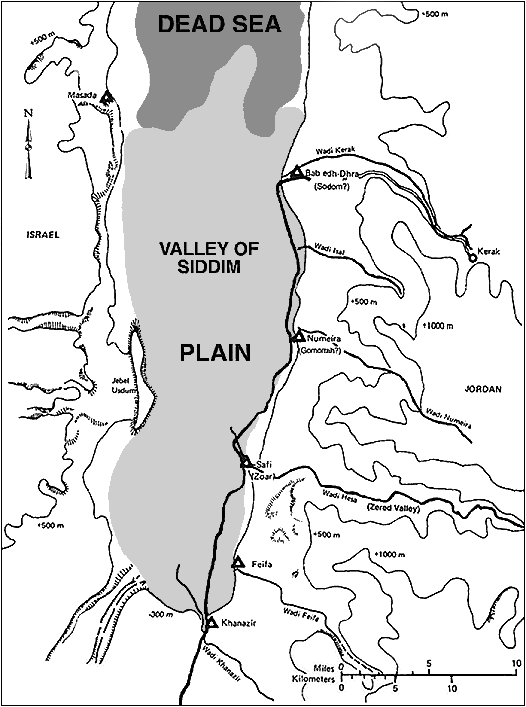
Cultural Marxism?") Sodom. A city once located in the fertile valley (kikkar, 3603, literally, "circle") of the Jordan River (Gen. 13:10-12). Moses' assessment of the city was blunt. "Now the men of Sodom were wicked exceedingly and sinners against the LORD" (Gen. 13:13). As the subsequent historical narrative reveals, the men of Sodom were "in-your-face" homosexuals (Gen. 19:1-11). God poured out his wrath in the form of sulfur and fire, not only upon Sodom, but also upon Gomorrah and upon "all the circle (kikkar)" (Gen. 19:24-29). Some scholars believe "Sodom was probably located in plain [sic] South of the Dead Sea, now covered with water." But the area once covered by water has now drained. Archaeologists have found no evidence of cities there. A more recent minority of scholars believe Sodom and the other "cities of the plain" or "valley" (literally, "cities of the circle") were located at the North end of the Dead Sea. This is even less likely because of the absence of any bitumen residue North of the Dead Sea (Gen. 14:10). The most likely suggestion is that Sodom is to be identified with Bab edh-Dhra, and Gomorrah with Numeira. In the parent article in Associates for Biblical Research, author Bryant G. Wood cites the cynical views of M. J. Mulder (article on Sodom and Gomorrah in Anchor Bible Dictionary) and Miller and Hayes (A History of Ancient Israel and Judah), but goes on to reject them. Wood concludes, When the archaeological, geographical and epigraphic evidence is reviewed in detail, it is clear that the infamous cities of Sodom and Gomorrah have now been found. What is more, this evidence demonstrates that the Bible provides an accurate eyewitness account of events that occurred southeast of the Dead Sea over 4,000 years ago. Note photos of (1) the area surrounding Bab edh-Dhra (proposed Sodom), highlighting a layer of ash in the western temple; (2) an excavated charnel (burial) house at Bab edh-Dhra; (3) the burn layer at Numeira (proposed Gomorrah). Note the diagram of the fault line in the Dead Sea valley. The fiery judgment upon Sodom and Gomorrah illustrates God's future fiery judgment upon the wicked (2 Pet. 2:6-10; Jude 1:6-7). "Sodomy" today remains a legal term. It used to be a prosecutable offense in America, but the "in-your-face" propagandizing of the modern homosexual movement has so permeated American society that deluded judges overthrow laws and force the nation not only to tolerate homosexuality, but to endorse it and celebrate it. The fiery judgment that befell ancient Sodom illustrates the judgment that will one day befall promulgators of homosexuality (Rev. 20:11-15; 21:8; 22:15).
Solomon, King. The son of David by Queen Bathsheba who ruled over Israel after his father. God told Solomon, "Ask what you wish Me to give you" (1 Kings 3:4). Solomon asked for an understanding heart to judge God's people and to discern between good and evil (1 King 3:9). God was so pleased at Solomon's wise request that He gave him not only wisdom, but also riches and honor (1 Kings 3:12-13). Thus Solomon excelled all the kings of the earth in riches and wisdom (1 Kings 10:23). Solomon's greatest accomplishment was his building of a glorious house in which Yahweh might dwell (1 Kings 5:1-6:38; 7:13-51). Solomon ruled peacefully over perhaps the greatest extent of territory of any previous or succeeding king of Israel (1 Kings 4:21). Son of David. A term in the NT identifying Jesus as the ultimate Son of David, and thus, the Jewish Messiah. In the NT, the phrase is used in Matthew’s Gospel ten times, more often than the rest of the NT combined. It appears in Matt. 1:1, 20; 9:27; 12:23; 15:22; 20:30, 31; 21:9, 15; 22:42. In Matt. 20:29-34, in Jericho, two unidentified blind men ask Jesus, as the Son of David, to have
mercy on them and give them their sight. They appeal to Him on the
basis of their belief that He is the Messiah. The only times this phrase does not refer to Jesus in Matthew is in Matt. 1:20 and in Matt. 22:42. In Matt. 1:20 a messenger of the Lord appeared to Joseph in a dream, urging him not to fear taking Mary as his wife, because the child which had been conceived in her was of the Holy Spirit. There, the messenger indicates the reality that Joseph belonged to the Messianic line. In Matt. 21:15 the scribes and chief priests were indignant that children in the temple were shouting to Jesus, “Hosanna to the Son of David!” They, sadly, were convinced that Jesus was not the Messiah, but an imposter. In Matt. 22:42, Jesus asked the Pharisees whose son the Christ (i.e., Messiah) was. They correctly answered that He was “The son of David,” literally, He was “of David.” So, answering Jesus’ question, the Pharisees, His enemies, without hesitation, correctly answered that the Christ, the Messiah, was the Son of David. They did not debate that. They only failed to acknowledge that Jesus was “The Son of David” – that He was the promised Jewish Messiah! The phrase “Son of David” is used three times in Mark’s Gospel: Mark 10:47, 48; 12:35. In Mark 10:47, 48 Mark cites only one blind man in the town of Jericho – blind Bartimaeus. Matthew had stated there were two (Matt. 20:31, 32). In the Gospel of Luke, the Messenger Gabriel predicted to Mary that her son would be called “the Son of the Most High;” and that “the Lord God will give Him the throne of His father David” (Luke 1:32). This was an indirect way of applying the phrase “the Son of David” to Jesus. In Luke 3:31, citing Jesus genealogical ancestry backward, Luke stated that Jesus was “the son of David.” In Luke 18:38, 39, an unidentified blind man twice called Jesus, “Son of David,” and In Romans 1:3 there is an indirect reference to Jesus as the Son of David. Paul identifies him as the Son of God, “the One having come into existence of seed of David according to flesh” (a literal translation). Conclusion: The most abundant references to Jesus as “Son of David” are to be found in the Gospel of Matthew. Definitively, “Son of David” refers to Jesus as being the promised Messiah. (This Glossary Entry added on February 20, 2026) Son of God. This Glossary entry is defined under three separate entries: Angels as "sons of God;" humans as "sons of God;" "Jesus as the "Son of God." Angels as "Sons of God. Forthcoming. Humans as sons of God. Forthcoming. Jesus as the Son of God. (1) The angel Gabriel told Mary her son would be called "Son of Highest" (Luke 1:32) and "Son of God" (Luke 1:35).
(2) Demons identified Jesus as "Son of God" (Matt. 8:29; Mark 3:11;
5:7). (3) The centurion guarding Jesus identified Him as truly being
"Son of God" (Matt. 27:54; Mark 15:39). The Apostle John five times referred to Jesus as God’s “only-born” Son (John 1:14, 18; 3:16, 18; 1 John 4:9). The Greek term employed there is monogenēs (3439), meaning, "only-born." The KJV uses the translation "only begotten" Son. That is correct, but the language is archaic. A more understandable translation is "only-born" Son. For example, John 3:16, literally translated, is as follows: "For God so loved the world that the Son, the only-born, He gave...." Let me say that one has to be born to be considered “only-born.” Jesus could not be God’s “only-born” Son until He was born as a baby in Bethlehem! Jesus was not God’s “only-born Son” until the Incarnation took place. Son of Man: This is a title that appears, eschatologically, in Daniel 7:13-14. There Daniel saw one like a son of man, coming with the clouds of heaven (see also Matt. 26:64; Mark 14:62). He approached the Ancient of Days (God Himself) and was given complete and eternal dominion over all the earth. All peoples and nations worshiped Him. This is a reference to the eternal reign of the Messiah, whom we now know to be Jesus of Nazareth. So we conclude that this term is a Messianic title. On another level it means, simply, "human." God repeatedly called Ezekiel "son of man" (Ezek. 2:1, 3, 6, 8, etc.). Jesus is referred to as "Son of Man" 88 times in the NT. Jesus is completely human, just as He is completely God. For Jesus, the term has the additional meaning that He is the Ultimate Man because He is the Messiah. Jesus repeatedly referred to Himself as "Son of man" (Matt. 8:20; 9:6; 10:23, etc.). He used it as a cryptic reference to Himself as the Messiah. He did not openly label Himself as the Messiah (Hebrew) or Christ (Greek), partly because He wanted people to come to that conclusion on their own, with the assistance of God's Spirit, of course (Matt. 16:13-17). Also, after Israel's leaders totally repudiated Him, stating that He performed miracles by the power of Satan, He obscured His Messianic ministry from the nation as a whole as an act of judgment. In summary, the title "Son of Man" as applied to Jesus was a Messianic title. Song of Ascents. The superscription or title of fifteen psalms (120:1-134:3) in the Psalter. These psalms were to be sung by worshipers ascending to Zion to worship Yahweh in His sanctuary. Most of the psalms are anonymous (Psa. 120:1-7; 121:1-8; 123:1-4; 125:1-5; 126:1-6; 128:1-6; 129:1-8; 130:1-8; 132:1-18; 134:1-3). Four were composed by David (Psa. 122:1-9; 124:1-8; 131:1-3; 133:1-3), and one by Solomon (Psa. 127:1-5). At least one of these psalms is post-exilic. The anonymous author vividly recalls the joy he and others experienced when Yahweh brought him and other exiles back from Babylon to Zion (Psalm 126:1-6). Many of these psalms are decidedly nationalistic. There are seven references to Zion (Psa. 125:1; 126:1; 128:5; 129:5; 132:13; 133:3; 134:3), five to Jerusalem (Psa. 122:2, 3, 6; 125:2; 128:5), and nine to Israel (Psa. 121:4; 122:4; 124:1; 125:5; 128:6; 129:1; 130:7, 8; 131:3). Six of these psalms are overtly nationalistic: Psa. 122:1-9, "A Joyful, Heartfelt Prayer for Jerusalem"; Psa. 125:1-5, "Assurance of Deliverance from the Evil Inherent in Foreign Domination"; Psa. 128:1-6, "The Blessings of Those Who Fear Yahweh!"; Psa. 129:1-8, "Israel's Acknowledgment of Yahweh's Deliverance from Haters of Zion"; and Psa. 132:1-18, "Yahweh's Revelation, in Response to Prayer, of His Choice to Reside in Zion, Blessing it through His Davidic Messiah". See the titles and links to all fifteen psalms with the superscription, "Song of Ascents." Sons of Israel. In general, a descriptive term for the physical descendants of Jacob, son of Isaac, son of Abraham. The Hebrew nomenclature is bene (1121) Yisra'el (3478). The descriptive phrase "Sons of Israel" occurs at least 600 times in the Bible. It first appears in Gen. 32:32 (32:33, MT), immediately after God changed Jacob's name from "Jacob" to "Israel." In the book of Genesis, more often than not, the term "Sons of Israel" refers to the immediate twelve sons of Israel or Jacob (see, for example, Gen. 42:5, 21; 46:5, 8; 50:25). But as the clan grew into a nation, the term was expanded to include the whole nation (e.g. Ex. 1:9, 12, 13; 2:23, 25; 3:9). In modern-day, secular usage, the term "Israeli" refers to a citizen of Israel living in the land. Those descendants of Abraham, Isaac, and Jacob who live outside the land of Israel are typically referred to as being "Jewish." (The term "Jew" is considered by Jewish people to be pejorative and offensive, and they prefer the adjectival description, "Jewish.") For the purposes of WordExplain, any ethnic descendant of Abraham, Isaac, and Jacob is considered to be one of the "Sons of Israel," no matter where or in what time frame he or she happens to live. The modern day equivalent of "Sons of Israel" is Israelis. In the Messiah's Millennial Kingdom, evidently only Israelis who have accepted Jesus as their Messiah will participate with Him in His Kingdom. The same will hold true throughout eternity in New Jerusalem, and upon New Earth. Incidentally, the NASB is one of the few translations that accurately translate bene Yisra'el as "Sons of Israel." Most modern Bible versions inaccurately translate the two word description as "people of Israel" or "Israelites" or "children of Israel." In my opinion, the reason for this is that most modern translators, whether they admit it or not, have succumbed to the disease of politically correct anti-masculinity, having surrendered ground to the religion of feminism. That is certainly not the case, of course, with ancient versions such as the King James Version, which routinely translates the words as "children of Israel." This illustrates my contention that the NASB ranks among the most accurate of English translations. Soteriology. The Study of Salvation. The term "soteriology" comes from two Greek words, sōtḗr (4990), "savior," "deliverer," "rescuer"; and lógos (3056), "word" or "messge" or, by application, "study" of. Soteriology focuses on God's rescue or salvation of man from the disastrous effects of sin, which include spiritual death, physical death, second death, aging, decay, disease, and entropy. God is rescuing man by means of Jesus Christ's sacrificial death on behalf of all mankind, climaxed by His resurrection. God's salvation through Christ is accessed only by faith in Jesus Christ. Topics in Soteriology include the following: What is the means of salvation? Is it by faith only, or by works? Can one lose his salvation? (See the discussion on Hebrews 6:1-8; see the discussion on Hebrews 10:26-31); Is water baptism necessary for salvation? What is God's Part in Salvation? What is Man's Part in Salvation? See also the off-site article, "What is Soteriology?" Southern Kingdom. The Southern
portion of the nation of Israel after
the division of the nation under Solomon's son, King Rehoboam. It was
termed Judah.
There was enmity between the Southern Kingdom and the Northern
Kingdom, sometimes called Israel,
sometimes called Ephraim (Isa. 7:17; 9:9; 11:13; Jer. 31:9; Hos. 5:3).
Later, Judah
came to be called Judea, as opposed to the Northern
Kingdom, Samaria. In Jacob's prophecy about
his twelve sons, he predicted that the scepter would not depart from
Judah (Gen.
49:10).
This was partly fulfilled when Jesus,
the Messiah,
was born of the tribe of Judah (Matt.
1:1-3, 16).
It will be more completely fulfilled when Jesus
returns to reign over Israel and
the world during the Millennium
(Psa.
2:1-12; Zech.
14:9; Rev.
19:11-20:6).
It will be most completely fulfilled when Jesus
Christ and God the Father jointly rule over New
Jerusalem and New Earth
from their throne located in New
Jerusalem (Rev.
22:1-3).
The Messiah
will obliterate the division between the two kingdoms and unite them in
one nation of Israel
(Isaiah 11:12-13; Jer. 3:18; Ezek. 37:16-17, 19, 22; Hos. 1:11). Sovereign, Sovereignty of God. The theological verity that God is the Supreme Ruler. On the human level, kings have limited sovereignty, limited authority. But God is the Supreme Ruler, and He has unlimited sovereignty. Fortunately for us humans, He is a good, or benevolent Sovereign. But He is also a holy, righteous Sovereign who requires accountability from all His human subjects. Let us list some of the areas in which God displays His Sovereignty. (1) He is said to be the Great King because He is the Creator (Ps. 95:3-5). (2) God is Sovereign because He is the Self-Existent One (Exod. 3:14). (3) God displays His Sovereignty in creating and calling humans to serve whatever purpose He chooses (Rom. 9:10-24). (4) God displays His Sovereignty in delegating man to excercize sovereignty over the earth and its animals (Gen. 1:26-28; 9:1-6). (5) God displays His Sovereignty in choosing certain individuals, without any merit on their part, to be beneficiaries of His eternal salvation (Eph. 1:4; 1 Thess. 1:4; 2 Pet. 1:10). (6) God displays His Sovereignty in assigning the descendants of Jacob, later renamed Israel, to rule over other nations of the earth (Gen. 27:29; Isaiah 2:1-4; 60:1-22; 61:5-6; Zech. 14:9, 12-19; Rev. 21:24-27). (7) God will display His Sovereignty in that Jesus, God's Anointed King of Israel and King of the Earth, will one day return to earth and be recognized as King of kings and Lord of lords (Rev. 19:16). (8) God will display His Sovereignty in His Eternal Kingdom (Rev. 21:1-22:5). (9) God will display His Sovereignty in the Eternal Torment of His enemies and all who reject the Good News concerning His Son (Matt. 25:41; 2 Thess. 1:8-9; Rev. 19:20; 20:10, 11-15). For additional information on this topic see the articles "God's Sovereignty," and "The Sovereignty of God." Speaking in Tongues. The Spiritual Gift of being able to speak in a foreign language one has never learned. At the onset of this gift on the Day of Pentecost, it served primarily as a tangible indicator of Jesus' Messianic arrival in heaven at the right hand of God and His outpouring of the Holy Spirit
on His followers just as He had promised them (John 14:16-17, 25-26;
15:26-27; 16:7-11, 12-15; Luke 24:49; Acts 1:1-8). This resulted in the
inauguration and subsequent expansion of the Church. (Acts 2:1-40).
Another purpose of the gift of speaking in tongues is revealed
in 1 Corinthians 14:20-22. There, Paul understood tongues-speaking to
be a fulfillment of the prophecy found in Isaiah 28:9-13. In this
diatribe, the Prophet Isaiah pronounced judgment upon the disbelieving
and disrespecting Israelis. They mocked Isaiah's prophecies, comparing
them to the process of teaching a small child, here a little, there a little, line
upon line, and precept upon precept. In retaliation, Isaiah, under the
inspiration of the Holy Spirit, predicted that Israel would be judged
by foreigners, who could not be understood, taking them into captivity
and holding them hostage for many years. Paul picked up on that
prophetic judgment, and declared tongues to be the equivalent of a
judgment upon unbelieving Israel. Because they would not believe in
Jesus as their Messiah, God would subject them to the speaking in
unlearned foreign languages by the early Church. Ultimately, God would
fulfill His prophecy in Isaiah by sending the Romans to destroy
Israel's temple and her capital of city of Jerusalem, and by dispersing
Jewish peoples all over the world. Paul's point to the Corinthian
believers was this: "Do not be childishly enamored with the gift of
tongues. It is a sign of judgment for unbelievers (1 Cor. 14:22)! Prophecy, on the
other hand, is a much more appropriate and productive gift for the upbuilding of believers (1 Cor. 14:22).
In 1 Corinthians 13 Paul revealed that both the gift of prophecy and
the gift of speaking in an unlearned language were temporary gifts. Prophecy (propheteia, 4394) would be terminated, and tongues (glossa, 1100) would cease to exist (1 Cor. 13:8). Faith, Hope, and Love, on the other hand, are eternal (1 Cor. 13:13). For a more detailed series of studies on Tongues-Speaking in the New Testament, see A Linked Summary of the Significance of Speaking in Tongues. Spirit. The driving essence and force of all beings higher than animal, whether man or messenger (angel). The NT term is pneuma (4151),
often referring to the Holy Spirit (Matt. 1:18, 20; 3:11, 16; 4:1; John
14:17, 26; 15:26; Acts 1:5, 8, 16; 2:4, 17; Rom. 8:11; 1 Cor. 2:14;
Eph. 1:13; 5:18; 1 Tim. 4:1; Heb. 2:4; 1 John 3:24; Rev. 1:10; 2:7;
17:3; 22:17); at times to unclean spirits (Matt. 10:1; Luke 6:18), also
known as fallen angels, i.e. angels who abandoned their allegiance to
God and submitted to the rule of Satan (Matt. 25:41; 2 Pet. 2:4; Rev.
12:7) or demons (Matt. 7:22; Luke 4:41; Rev. 9:19). Sometimes the term
refers to the human spirit (Matt. 26:41; John 11:33; 13:21). Sometimes
the term refers to "breath" or "wind" (John 3:8). Spiritual. Of, or pertaining to the Holy Spirit. The Greek adjective is pneumatikós (4152). It usually refers to the Spirit of God (1 Cor. 2:13), but occasionally to evil spirits (Eph. 6:12). Spiritual people have been regenerated by the Spirit of God on account of their faith in Jesus Christ as the Messiah. Unsaved people possess the spirit of the world, not the Spirit of God (1 Cor. 2:12). Christians have received the Spirit of God, and so they have the capacity to "know the things freely given to us by God" (1 Cor. 2:12). Unfortunately, Christians, even though they possess the Spirit of God, also retain their fallen sin nature, oftentimes referred to as "the flesh." When Christians, who have the Holy Spirit within, instead walk, or live their lives controlled by their flesh (Rom. 8:4) instead of controlled by the Holy Spirit (Gal. 5:16), the results are disastrous (Gal. 5:19 -21). When a Christian walks, or lives his life, by the power of the Holy Spirit, he is spiritual, and the results are marvelous (Gal. 5:22-23; cf. Eph. 5:18-21; cf. Eph. 5:22-6:20). Another result of the Christian's possessing the Holy Spirit is that He imparts Spiritual Gifts to the individual (1 Cor. 12:1; 14:1). A Spiritual Gift is a God-given ability to serve Him acceptably and efficiently with good results. Biblical discussions of Spiritual Gifts include Rom. 12:3-8; 1 Cor. 12:1-31; Eph. 4:11-13; 1 Pet. 4:10-11).
Spiritual Birth. The act of God whereby He makes alive a spiritually dead sinner who has placed his faith in Jesus Christ. In his opening comments in his gospel, the Apostle John recorded that, though Jesus came to His own creation, His own people, the people of Israel, did not receive Him (John 1:11). On the other hand, to as many as did receive Him, also defined as those believing into Jesus' name, to them Jesus gave the authority to become children of God (John 1:12). These individuals John described as having been born (gennaō, 1080) not of bloods, nor of the will of flesh, nor of the will of a male, but of God (John 1:13). This concept of spiritual birth is also found in Jesus' statement to Nicodemus that he needed to be "born" (gennaō, 1080) "again" or "from above" (anōthen, 509) (John 3:3, 7), or else he could neither see nor enter the kingdom of God (John 3:3, 5). Another term for "spiritual birth" used in Scripture is that of "regeneration." The term "regeneration" (paliggenesia, 3824) in this sense is used only in Titus 3:5. The literal meaning of paliggenesia (3824) is from pálin (3825), "again" and génesis (1078), birth" or "beginning." Spiritual birth, or regeneration, is necessary inasmuch as when man is born physically, he is already dead spiritually, i.e., separated from God (Eph. 2:1). We inherited a sin nature from our parents, and anyone who insists he has no sin (nature) is merely deceiving himself and is bereft of the truth (1 John 3:8). God's salvation is not based upon deeds which we have done in righteousness, but upon His mercy (Tit. 3:5). His salvation is accomplished by the washing (loutron, 3067) of regeneration (paliggenesia, 3824) and by renewing (anakainōsis, 342) accomplished by the Holy Spirit (Tit. 3:5). Similarly, Jesus linked the new birth in John 3:5-8 to the activity of the Holy Spirit. Both Roman Catholics and certain mainline Protestant denominations believe that the "washing of regeneration" in Tit. 3:5 and the water in John 3:5 refer to water baptism. But the noun "washing" (loutron, 3067) in Tit. 3:5 refers to a bath or bathing, not to baptism (baptisma, 908). And the washing is defined as being "regeneration," not baptism. And in the context of Jesus' and Nicodemus' discussion, being "born of water" in John 3:5 far more likely refers to natural birth ("that which is born of the flesh is flesh") (John 3:4, 6) than it does to the ceremonial act of baptism. How can physical water ever cleanse a sin-polluted soul or spirit? Water baptism can no more regenerate a sinner or wash away his "original sin" than circumcising an Israeli's organ of procreation could circumcise his heart (Romans 2:29). See Four Different Types of Baptism. The Roman Catholic explanation of Titus 3:5; of John 3:5. Return to text. I have attended Lutheran funerals in which the pastor intoned that the deceased "put on Christ" when he was baptized. Return to text. Spiritual Death: The state of man's alienation from God. We define any kind of death as essentially, "separation." In the case of Spiritual Death, man is separated from God and alienated from Him. This alienation began with man's sin in the Garden of Eden. Each of us have inherited Spiritual Death from our parents, as each of us is traceable back to Adam. We were born with a Sin Nature, an inherited tendency to rebel against God. To deny that we have a sin nature is to deceive ourselves (1 John 1:8). Inevitably our sin nature breaks out into acts of sin (Rom. 3:23; 1 John 1:10). The wages of sin is death (Rom. 6:23). So each of us is born spiritually dead and in the process of dying physically. The only remedy for Spiritual Death is Spiritual Birth. We must be born again, or born from above (both are true) (John 3:3-8). Another term for this is regeneration, being made spiritually alive. We are born again, spiritually, into the family of God when we receive Jesus, the Word of God (John 1:1-2) and Creator of the world (John 1:3, 10), and believe in His name (John 1:11-12). Then we are born of God (John 1:13). Jesus is the Word of God who became human flesh and lived among mankind, and fully explained God (John 1:14-18). He is the Lamb of God who takes away the sin of the world (John 1:29). He is the only Way to be reconciled to God and have eternal life (John 3:16-18; 14:6). If Spiritual Death is not remedied by Spiritual Birth before the onset of Physical Death, there is no hope for a remedy. Without spiritual rebirth, the end result is inevitably Second Death, eternal separation from God in the Lake of Fire (Rev. 19:20; 20:10, 14; 21:8). Spiritual Gift. A special, God-given ability to serve Him during the Church Age. The Holy Spirit seems to be the One who distributes gifts (1 Cor. 12:4-11). One or more gifts have been given to each Christian (1 Cor. 12:7; Eph. 4:7). Some Christians (like the Apostle Paul, for example) have been given multiple gifts. A spiritual gift is given on the basis of God's grace (Eph. 4:7), not on the basis of human merit. Christians are exhorted to focus on the gifts they have been given rather than mourn for the gifts they have not been given (1 Cor. 12:29-30). The main passages on spiritual gifts include Rom. 12:3-8; 1 Cor. 12:1-14:40; Eph. 4:11-12; 1 Pet. 4:10-11. There is a hierarchy, or ranking of gifts (1 Cor. 12:28; Eph. 4:11-12). In my opinion, certain gifts are temporary, and have ceased, at least for the time being. Paul, for example, singled out prophecy, tongues, and (special) knowledge as three of them (1 Cor. 13:8-10). Since the conclusion of the book of Revelation in about A.D. 96, there have been no new writings added to the corpus of Scripture. That is unprecedented if there are still prophets today. We know that prophecy will resume at least during the Tribulation (Rev. 11:1-14), but the two witnesses are not part of the Church, either. For further study, see Do Prophets Exist Today?; Do Apostles Exist Today?; A Linked Summary of the Significance of Speaking in Tongues. Spiritual Israel. The widely-held, but exegetically bankrupt belief that the Church has replaced Israel, and that there is no future for Israel as a nation. This belief is based upon a metaphorical, and thus non-literal exegesis of pertinent OT passages predicting a future for the nation of Israel. With the bias against God's favorite nation of Israel in the OT, that same bias is extended into the NT. Those who believe in the Church as being "Spiritual Israel" arrive at faulty conclusions in passages such as Gal. 3:28-29 and Eph. 2:11-22. Typically, those who hold to the dogma of the Church replacing Israel as "Spiritual Israel" do violence to the plain meaning of eschatological texts in both the OT and the NT. Spiritual Presence View.
The interpretation of Presbyterians and some other followers of John
Calvin of the elements of the Lord's Table. This view holds that, in
the elements of the Lord's Table, the bread and wine communicate the
spiritual presence of Christ. This view was proposed by Martin Bucer
and followed by John Calvin. The other three views are Transubstantion,
Consubstantion, and Memorial. According to the Department of Energy, The Standard Model of Particle Physics is
scientists’ current best theory to describe the most basic building
blocks of the universe. It explains how particles called quarks (which
make up protons and neutrons) and leptons (which include electrons)
make up all known matter. It also explains how force carrying
particles, which belong to a broader group of bosons,
influence the quarks and leptons.
The
Standard Model explains three of the four fundamental forces that
govern the universe: electromagnetism, the strong force, and the weak
force. Electromagnetism is carried by photons and involves the
interaction of electric fields and magnetic fields. The strong force,
which is carried by gluons, binds together atomic nuclei to make them
stable. The weak force, carried by W and Z bosons, causes nuclear
reactions that have powered our Sun and other stars for billions of
years. The fourth fundamental force is gravity, which is not adequately
explained by the Standard Model (emphasis mine). The model is inconsistent with the
emerging Lambda CDM model of
cosmology. (Emphasis mine.) Contentions include the absence of an explanation in the
Standard Model of particle physics for the observed amount of cold dark
matter (CDM) and its contributions to dark energy, which are many
orders of magnitude too large. It is also difficult to accommodate the
observed predominance of matter over antimatter (matter/antimatter
asymmetry). The isotropy and homogeneity of the visible universe over
large distances seems to require a mechanism like inflation which
would also constitute an extension of the Standard Model. Currently,no
proposed theory of everything has been widely accepted or verified. (Emphasis mine.) (Editor's note: "Lambda" is shorthand for "Dark Energy.")
(Editor's
note: The contributor to the Wikipedia paragraph is, in my judgment,
disingenous when he speaks of "observed amount of cold dark matter." In
fact, no one has ever observed cold dark matter.
It weighs nothing and generates no light. And no experiment that I am
aware of has ever verified "cold dark matter." An accurate conclusion
is that CDM is outside the realm of observable, verifiable science. It
has only been postulated to coincide with the mechanics of the
postulated (but never observed or reproduced in an experiment)
Big Bang. The same goes for Dark Energy. The Standard Model of
Particle Physics has been very useful in describing and predicting. But
if the Big Bang is true (and I do not believe it is), then the Standard
Model of Particle Physics is not an accurate explanation of things as
they exist in our universe. You can't have it both ways. Either the
Standard Model of Physics is true and the Big Bang is not, or else the
Big Bang is true and the Standard Model of Physics is not. At least the
contributor is correct when he admits, "Currently, no proposed theory
of everything has been widely accepted or verified.)
(Editor's note: There is one explanation that explains everything that exists in the universe. That is that God created the heavens and the earth and everything in them in six days. The evil we see in our universe is also explainable. The personification of evil, the Devil, tempted the first couple and they succumbed. God holds the man, Adam responsible. Then God cursed the universe as a punishment. The Bible also reveals that evil became so rampant that God judged the whole world with a universal flood, Noah's Flood. That, and not evolution over millions of years, accounts for the extensive fossil record buried in sedimentary layers of rock all over the globe. Furthermore, God will one day judge the entire universe, igniting both the heavens and the earth in searing flames that will destroy all of matter in the whole universe (2 Pet. 3:7, 10-12; Rev. 20:11). Then He will create a New Heavens and New Earth (Rev. 21:1), with New Jerusalem as its capital city (Rev. 21:2, 10-26; 22:1-5). That universe will contain only righteousness and righteous people (2 Pet. 3:13, 14) -- people who have accepted Jesus as their King and have accepted His voluntary, substitutionary death on behalf of all people in payment for their sins and their imbedded evil. Only those who accept the King, His sacrifice, and His resurrection on their behalf, will be resurrected to participate in the New Universe. The remainder of humanity will suffer interminably in what the Bible calls "The Lake of Fire" (Rev. 20:14-15; 21:8). I urge the reader to make Jesus your King. He is your only hope!) Stephen. The Church's first martyr. Stephen was one of seven Hellenistic Jews chosen by the early church to oversee the serving of tables equitably so that neither the Jewish Christian widows nor the Hellenistic Jewish Christian widows felt as though they were being discriminated against in the distribution of food (Acts 6:1-4). Stephen was listed first. He was a man "full of faith and the Holy Spirit" (Acts 6:5). I believe Stephen was one of the "Proto-Deacons," though these seven were not listed by that title. God had even greater plans for Stephen. He was "full of grace and power," and "was performing great wonders and signs among the people" (Acts 6:8). However, some men from the "Synagogue of the Freedmen" took exception to what Stephen was teaching (Acts 6:9). But they were unable to cope with the wisdom and power granted by the Spirit with which Stephen was speaking (Act 6:10). As many evil men do, they were so persuaded of the rightness of their cause that they induced false witnesses to testify inaccurately about Stephen. These false witnesses accused Stephen of speaking blasphemous words against Moses and against God (Acts 6:11). They dragged him before the Council (sunedrion, or Sanhedrin, 4892) (Acts 6:12). This time the false witnesses accused Stephen of speaking incessantly against the Temple, and the Law (Acts 6:13). They accused Stephen of teaching that Jesus would destroy the Temple and alter the customs handed down by Moses (Acts 6:14). Those in the Council saw Stephen's face like that of an angel (Acts 6:14). How ironic that the glory of God shone from Stephen's face just as it had shown from the face of Moses! Acts 7:1-53 is Stephen's defense. Over-all, he concluded that they and their fathers, not he, had repudiated Moses. Moreover, God doesn't live in a temple anyway -- He is much bigger than that (Acts 7:1-50). (1) God appeared to Abraham outside the land of Canaan (Acts 7:2-8). (2) The patriarchs were jealous of Joseph, but God granted Joseph favor in Egypt, outside the land of Canaan (Acts 7:9-10). (3) Through Joseph, God moved the nation of Israel to Egypt. The patriarchs were buried in a tomb that Abraham had been forced to purchase (Acts 7:11-16). (4) Moses attempted to rescue the nation from the cruel Egyptians, but the people of Israel rejected Moses as their leader (Acts 7:17-29)! Moses had to flee for his life to the land of Midian. (5) In the desert, God called Moses to rescue His people (Acts 7:30-34). (6) But the people of Israel rejected Moses, the Law, and God (Acts 7:35-43)! (7) Next, Moses recited the history of the tabernacle and temple (Acts 7:44-49). He cited Isaiah as quoting God, "Heaven is My throne, and Earth is the footstool for My feet. What kind of house will you build for Me? Or what place is there for My repose? Was it not My hand that made all of these?" (Isa. 66:1-2; Acts 7:49-50). Stephen's conclusion: They, not he, are violating Moses' Law by having murdered the very prophet that Moses had predicted! They were just as stiff-necked as their fathers! You received the Law as ordained by angels, yet you did not keep it (Acts 7:51-53). At this, they were cut to the quick and began gnashing their teeth at him (Acts 7:54) Full of the Holy Spirit, Stephen gazed into heaven, saw the glory of God, and Jesus standing at God's right hand. He said, "Behold, I see the heavens opened up and the Son of Man standing at the right hand of God!" (Acts 7:55-56). The enraged Council proceeded to stone Stephen to death, laying their robes at the feet of a young man named Saul (Acts 7:57-59). As he was dying Stephen cried out, Lord Jesus, receive my spirit, and do not hold this sin against them! (Acts 7:59-60). Thus, Stephen became the first martyr of the early Church. Strong's Definitions. "... a collection of the unique Greek and Hebrew words and their definitions from the Old and New Testament, organized by Dr. James Strong in 1890." ... "Our descriptions ... are based upon those found in The New Strong's Exhaustive Concordance of the Bible." WordExplain's links to Strong are based on the definitions contained in BlueLetterBible.org.
Subjunctive
Mood.
The Greek mood that indicates potential or possibility in conditional
statements or definite outcome in purpose or result clauses. See an
offsite Shorter
Definition by Larry Keating; or a more detailed
Table outlining uses of the Greek Subjunctive in Independent,
Dependendent, and hína
Result clauses, also by Larry Keating; or see also Keating's "Framed
View."
"Hortatory (exhortational) Subjunctive" is the term given to a first person plural Subjunctive verb often appearing near the beginning of the sentence. It is a statement urging oneself and one's associates or, in an epistle, one's readers, to join in some action. It is typically translated, "let us ______...." For all practical purposes, a "Hortatory Subjunctive" carries the force of an Imperative. An example is found in 1 John 4:7, where John exhorts himself and his readers, "Beloved, let us be loving one another" (JTB translation). Substitutionary Atonement. The theological concept that Jesus Christ, by virture of His death on the cross, voluntarily paid the price for human sin in the place of all humans. Two components are involved – that Jesus was our substitute, and that His substitionary death paid the price for human sins. Substitutionary Atonement is a biblical concept, but, technically speaking, these words never occur in the NT. In the OT, the Hebrew verb "atone," almost always in the NASB translated "make atonement," kâphar´ (3722) appears 102 times. In the Greek translation of the OT, the LXX, the verb used to translate kâphar´ is exilaskomai, but it never appears in the NT. Here are some Scriptures which teach the concept of Substitutionary Atonement. In the OT, it is taught in Isaiah 53:5. In the NT, it is taught in 2 Cor. 5:21; 1 Pet. 2:24; 3:18. The reader should be aware that Jesus' sacrifice was valuable enough to serve as a propitiation for the sins not only of believers, but of the entire world (1 John 2:2). However, Jesus' death is effective only for those who believe in Him (John 3:16-18, 36; Acts 13:38-39). See the Glossary entry on Atonement. Supersessionism. The view of Amillennialists,
that the Church
has permanently superseded the nation of Israel
in God's redemptive program. According to Michael Vlach, there are three
different forms of Supersessionism - punitive,
economic, and structural. Punitive
Supersessionism.
In this view, God has punished Israel
for her disobedience. In
particular, Israel's
rejection of Jesus as her Messiah has eliminated the nation from God's
covenantal love. Correspondingly, Israel
is now the
object of God's punishment or retribution. Punitive Supersessionism has
been the view of Hippolytus, Origen, Lactantius, and Martin Luther.
Economic Supersessionism. In this model, the issue is not so much that Israel's disobedience culminating in her rejection of her Messiah warrants God's retribution. Rather the issue is that, in the providence of God, His eternal plan has always been to displace Israel with the Church. In this view, the term "economic" has nothing whatever to do with finances, but everything to do with God's plan for administering His redemptive program. In this view, Israel's role on the stage of human history has expired. Now God has administered His superior plan to redeem the world through the Church. With Christ's advent, God's program for physical, material Israel has been rendered obsolete. The Church now constitutes the true Israel. Adherents of Economic Supersessionism include Rudolf Bultmann, Vern S. Poythress, Karl Barth, and N. T. Wright. Structural Supersessionism. This view is based upon a supposed treatment of the canon of Scripture and the whole Biblical narrative by the Christian community. P.Kendall Soulen has stated that the whole canonical narrative, since the time of Justin Martyr and Irenaeus, has hinged on four key episodes - 1) The creation of our first parents (Gen. 1:1-2:24); 2) the fall of man (Gen. 3:1-24); 3) the incarnation of Christ and the inauguration of the Church (the Gospels and the Epistles); and 4) the final consummation (apocalyptic passages such as Matthew 24:1-25:46 and Revelation 6:1-22:21). In this view, Christendom essentially overlooks the vast portion of the Hebrew Scriptures. This view minimizes the explicit statements of Scripture, particularly in the Old Testament, and focuses merely on how the great bulk of the Church has treated those Scriptures. If the Church has permanently superseded Israel, a number of questions remain eternally unanswered. What did God mean when He said He would establish an "everlasting covenant" with Abraham and his descendants that included the land of Canaan as an "everlasting possession" (Gen. 17:8-9)? What did God mean when He told Abraham He would establish His covenant with Isaac "for an everlasting covenant for his descendants after him" (Gen. 17:19)? Why did Jacob, near his death, relate that God had personally promised to give to him and to his descendants "this land" "for an everlasting possession" (Gen. 48:3-4)? If God is through with Israel, why did He name the eternal capital of New Earth "New Jerusalem" (Rev. 21:2, 10)? Why not New York or New Delhi? Why are the gates of New Jerusalem named after the twelve sons of Israel (Rev. 21:12)? If there is no eternal distinction between Israel and the other nations, then who are the nations (ethne) that live and work on New Earth, governed by kings, and who walk by the light of New Jerusalem and bring their glory and honor into the city and there benefit from the restorative qualities of the leaves of the Tree of Life (Rev. 21:24-26; 22:2)? If distinctions between the Nation of Israel and the other nations no longer exist, why even use the term "nations" at all since it has ostensibly become outmoded? And finally, can God be trusted to keep His promises? If God cannot be trusted to keep His land and people promises to the sons of Israel, why do we Gentiles in the Church think God will keep His promises of eternal life to us? Isn't that more than a little arrogant of us (Rom. 11:17-21)? See also Replacement Theology. Dr. Michael Vlach has written some excellent articles on Supersessionism. Foremost among them is "12 Reasons Why Supersessionism / Replacement Theology Is Not a Biblical Doctrine." Synagogue. The focal point of Jewish worship and community beginning in the time of Israel's Babylonian exile. Since the temple was not available for these exiles, they commenced an alternative worship site. Some aspects of Judaism believe that the form of worship in the synagogue "did not crystallize until the destruction of the Temple" in A.D. 70. That, however, does not really square with the NT, which shows a defined pattern of worship even during the days of Jesus and the NT Apostles. Presumably exiles returning to Judea from Babylon brought these worship patterns with them. The Greek noun sunagoge (4864) appears 56X in the NT. Jesus routinely taught in the synagogues (Matt. 4:23). There was giving (Matt. 6:2) and prayer (Matt. 6:5) in the synagogues. Synagogues served at times as a venue for courts (Matt. 10:17; Luke 12:11; 21:12). There was a "pecking order" in the synagogues, where men of distinction had preferred seats (Matt. 23:6). Jewish people met in the synagogues on the Sabbath day (Mar. 6:2). It was customary to read from scrolls of books of the Hebrew Bible housed in the synagogues. There was evidently a lectionary of sorts -- Jesus was once handed the scroll of the prophet Isaiah from which to read as he stood up (Luke 4:16-19). It was customary for a teacher, or rabbi, to sit as he taught (Luke 4:20-21). After the founding of the Church at Pentecost, and commencing with the assignment of Saul and Barnabas to begin taking the Good News about Jesus to the ends of the earth (Acts 13:1-3), missionaries routinely searched for synagogues as the ideal places to plant new churches. In the synagogues there was typically a ready-made nucleus of people who were already believers in God and in the Scriptures. When these Jewish people heard the Good News about Jesus, many often initially responded enthusiastically. And not only they, but God-fearing Gentiles attending the synagogues also readily subscribed to the electrifying revelations about Jesus being the promised Messiah. Examples of missionary teams planting churches from the spiritual nucleus of synagogues include the following: Acts 13:5, 14, 43; 14:1; 17:1, 10, 17; 18:19; 19:8. Modern Jewish designations: A loose definition of "synagogue" is "Jewish House of Worship." The Hebrew designation is Beit K'nesset (literally, "House of Assembly"). This translation is rarely used in English. Orthodox and Chasidim typically use the word "shul," a Yiddish term. This comes from the German word for school, and emphasizes the process of studying the Scriptures. Conservative Jews typically use the word "synagogue," actually a Greek translation of Beit K'nesset, meaning "Place of Assembly." Reform Jews use the word "Temple" because they consider their places of worship a replacement of or equivalent to the Hebrew Temple, no longer in existence since the Romans destroyed it A.D. 70. |
|||||||||||||||||||||||||||||